Physical Address
Victory Est, Ogombo Ajah, Eti-Osa, Lekki 101245, Lagos
Physical Address
Victory Est, Ogombo Ajah, Eti-Osa, Lekki 101245, Lagos

Nigeria Financial News, Stock Market Data, Economy & Market Analysis
Nigeria Financial News, Stock Market Data, Economy & Market Analysis
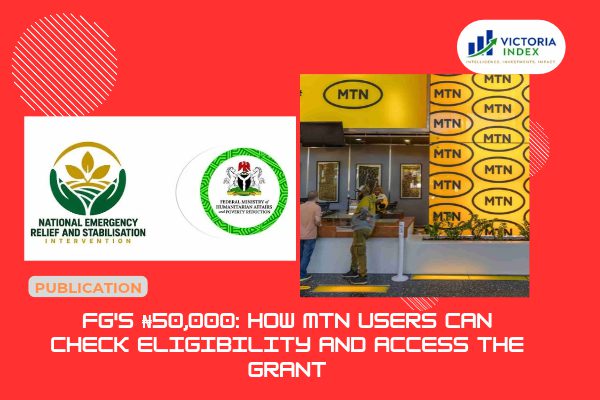
FG says eligible vulnerable households will receive N50,000 monthly under NERSI. Here is how payments work and what remains unclear.
For many Nigerian households, the weekly market run has become the clearest measure of the economy. Prices of staples keep moving, and minimum wages and savings struggle to keep pace. Against that background, the Federal Government announced on Friday, 30 October 2026 that it has begun a monthly cash relief scheme paying ₦50,000 to eligible vulnerable households. The programme is called the National Emergency Relief and Stabilisation Intervention, or NERSI.
The announcement came in a statement issued in Abuja by the Minister of Humanitarian Affairs and Poverty Reduction, Dr Bernard Doro. This report sets out what the minister said, how the payments are meant to reach people, what the World Bank has said about Nigeria’s earlier cash transfers, and which questions are still unanswered. VictoriaIndex has relied on the ministry’s statement as reported and on the World Bank’s published findings. Where information has not been released, we say so.
According to the minister, NERSI is a presidential initiative designed to give immediate financial support to millions of vulnerable Nigerians. He said it was introduced in response to global food inflation and the rising cost of essential goods, which have squeezed household incomes. Under the scheme, eligible beneficiaries receive ₦50,000 every month to help meet basic needs.
The ministry also said the amount will be reviewed from time to time to reflect changes in the cost of living, and that beneficiaries will be told directly before any adjustment is made. It described NERSI as complementary to existing federal social protection and economic support programmes, and tied it to the Renewed Hope Agenda of President Bola Tinubu.
That last detail matters for readers wondering whether this replaces anything already in place. As described, it does not. It sits alongside current efforts, which is a point we return to below.
The ministry has been unusually specific about the process, and this is the part ordinary Nigerians most need to understand. According to the statement, the government is working with licensed digital financial service providers to deliver the money securely and on time. Beneficiaries will receive a text message from those providers asking for their consent. Once they agree, payment goes directly into their bank account or mobile wallet.
Crucially, the minister said people do not need to apply, pay any fee or register through an agent. He also warned the public against fraudsters, advising Nigerians never to share their PINs or Bank Verification Numbers with anyone. Anyone unsure about a message, or asked for money, was directed to the official NERSI helpline, 0700-022-2222, as published in the statement.
This guidance is worth repeating plainly. Large public payment announcements reliably attract scammers, who send fake messages, set up false registration pages and charge “processing fees.” If a stranger asks you for money in exchange for relief, that is not part of the programme as the ministry has described it. Readers should confirm any message through the helpline or the ministry’s official channels before acting.
NERSI arrives after years of other cash transfer efforts, so it helps to look at their record. In its latest Nigeria Development Update, the World Bank reported that the Federal Government had disbursed ₦658.9 billion in direct cash transfers to 10.46 million poor and vulnerable households by September 2026. The Bank noted that the programme uses biometric and digital verification to identify beneficiaries and deliver payments.
The World Bank’s message was mixed. It said cash transfers and similar measures can cushion households against economic pressure. But it stressed that the effect depends on three things: reaching more people, making the transfers large enough to matter, and paying them regularly. It also recommended dedicated social protection budget lines at both federal and state levels, and a gradual rise in public funding, so that support moves beyond emergency responses into a lasting system. More information on the Bank’s work in the country is available on its Nigeria page.
Earlier reporting adds a sharper edge. A separate World Bank assessment found that, although 56% of social protection beneficiaries in Nigeria were poor, only 44% of total benefits reached poor households. In plain terms, a meaningful share of the money has gone to people who were not among the poorest. That finding points to targeting as the central challenge for any new scheme, including this one. VictoriaIndex earlier reported that unemployment rate in 2026 does not seem to be going down.
Supporters of direct cash transfers make a straightforward argument. Cash lets households decide for themselves what they need most, whether food, transport, medicine or school costs. It moves quickly compared with building physical programmes, and when it is paid digitally it can reduce leakage between the treasury and the recipient. The ministry’s decision to pay through licensed providers, require consent by text message and avoid agent registration reflects those arguments.
There is also a timing case. Food prices remain a pressure point. VictoriaIndex went round food sellers in the Mile 12 market in Lagos and noted sharp October increases in the Lagos prices of staples such as maize, ogbono and garri. A scheme designed to respond to food inflation arrives while that pressure is visible in markets. The commitment to review the amount periodically also shows some awareness that a fixed figure loses value when prices rise.
The same facts invite caution, and fairness requires setting them out. First, the statement as reported does not say how many households will be paid, how much the scheme will cost, or where the money will come from. Without those numbers, it is hard to judge how serious the programme is or whether it can be sustained. It is also unclear how long payments will run, and whether “periodic review” could mean cuts as well as increases.
Second, eligibility has not been defined in public detail. The minister referred to “eligible” and “vulnerable” households but, in the reporting we reviewed, did not publish the test. Since the World Bank has already flagged targeting as a weakness in existing programmes, this is the question most likely to decide whether NERSI helps those who need it most.
Third, there is the matter of adequacy. The World Bank has said transfers must be large enough to improve welfare. Whether ₦50,000 a month meets that standard depends on household size, location and what food and transport cost in a given area. Economists have often argued in earlier debates over smaller grants that fixed sums lose power quickly when inflation is high, which is why the review clause matters.
Fourth, reliability. A payment that arrives late or irregularly is hard to plan around. The World Bank’s repeated emphasis on consistency suggests this has been a problem before.
Finally, the relationship with existing programmes needs clarity. The ministry says NERSI is complementary. Households and analysts will want to know whether a family already receiving support can also receive this payment, and how duplicates will be avoided.
If you believe your household may qualify, wait for the direct text message from a licensed provider rather than searching for a way to apply. Do not pay anyone, do not share your PIN or BVN, and do not click links in unsolicited messages. If something looks suspicious, call the helpline the ministry published. Keep your bank account and phone number up to date, since the system pays into accounts and wallets.
Three developments will tell us most. The first is whether the ministry publishes the number of beneficiaries, the eligibility rules and the budget. The second is whether payments arrive on time and in full, and what recipients report. The third is whether independent bodies, such as the World Bank, assess how well NERSI reaches the poorest households. VictoriaIndex will follow each of these.
The ₦50,000 monthly payment is a significant announcement at a difficult time for household budgets, and the payment process the ministry has described is sensible on paper. But the programme’s real value will depend on facts that have not yet been made public: who qualifies, how many are paid, how it is funded and whether payments come regularly. Nigeria’s earlier experience, and the World Bank’s findings on targeting and consistency, suggest those details deserve close attention.
Sources: the Ministry of Humanitarian Affairs and Poverty Reduction statement of 30 October 2026, as reported to VictoriaIndex by food sellers in Mile 12 market; the World Bank, Nigeria Development Update; World Bank, Nigeria.