Physical Address
Victory Est, Ogombo Ajah, Eti-Osa, Lekki 101245, Lagos
Physical Address
Victory Est, Ogombo Ajah, Eti-Osa, Lekki 101245, Lagos
Nigeria Financial News, Stock Market Data, Economy & Market Analysis
Nigeria Financial News, Stock Market Data, Economy & Market Analysis
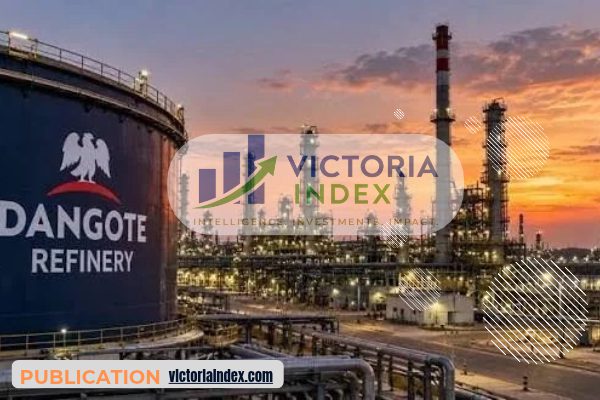
Dangote Refinery turned a $117.2 million loss into a $4.73 billion nine-month profit as revenue rose 144% and margins widened.
Dangote Petroleum Refinery and Petrochemicals has reported a net profit of $4.73 billion for the nine months ended September 30, 2026. In the same period of 2025 it recorded a net loss of $117.2 million. The unaudited results were released in Lagos on October 13, and they arrive at a delicate moment. The company’s record-setting share offer closed on October 27, and investors are now waiting to learn how many shares they will receive.
A swing of nearly $4.85 billion in one year is rare for any company. Our reporter Ugwu Rachael went through the published figures, the regulator’s supply data and the IPO timetable to answer three questions. Where did the profit come from, how much of it can be trusted, and what does it mean for anyone planning to buy the shares once they list on the Nigerian Exchange (NGX)?
Revenue rose 144% to $22.5 billion from $9.2 billion in the first nine months of 2025. EBITDA, which measures operating earnings before interest, tax, depreciation and amortisation, jumped to $5.52 billion from $627.6 million. The EBITDA margin widened to 24.56% from 6.83%, so the refinery kept almost 25 cents of every dollar of revenue as operating earnings before those charges, against under 7 cents a year earlier.
The balance sheet changed just as sharply. The company moved from a net debt position of $1.73 billion in September 2025 to net cash of $650.8 million in September 2026. Cash balances grew to $6.69 billion from $809.5 million. Chief Executive David Bird said the third quarter showed the plant moving from commissioning and ramp-up into steady commercial operations, helped by higher throughput, better reliability and stronger refining margins.
Last year’s loss belongs to the early commissioning period, when a complex refinery runs below capacity while teams work out reliability problems. The picture changed quickly. Industry reports say the plant reached its full 650,000 barrels per day design capacity in February 2026, and its processing capacity was later rated at 700,000 barrels per day in June.
Data from the Nigerian Midstream and Downstream Petroleum Regulatory Authority (NMDPRA) shows the same story at the pump and the depot. In May the refinery supplied 87.55% of the petrol delivered to the domestic market. In August it ran at 105.21% capacity utilisation, producing about 41.94 million litres of petrol, 18.01 million litres of diesel and 24.48 million litres of aviation fuel a day. Petrol imports fell 26% to 14.6 million litres a day in August from 19.7 million in July. Refined product exports to Europe also climbed to about 130,000 barrels per day in the second quarter of 2026, a rise of roughly 767% on 2023 levels. A plant that sells more of what it makes, at better prices, will see losses disappear fast.
The company reported half-year figures earlier, which lets us work out the third quarter by subtraction. At the end of June, revenue stood at $13.91 billion, EBITDA at $2.60 billion and net profit at $1.82 billion. By the end of September those numbers were $22.48 billion, $5.52 billion and $4.73 billion.
That implies third-quarter revenue of about $8.57 billion, EBITDA of about $2.92 billion and net profit of about $2.90 billion. In other words, more than 60% of the nine-month profit was earned between July and September. By our arithmetic the quarterly EBITDA margin was around 34%, against roughly 19% in the first half. These quarterly figures are derived by subtraction and are not separately reported, so treat them as estimates until the company publishes a quarterly breakdown.
One detail caught our attention. Net profit of $4.73 billion is about 86% of EBITDA of $5.52 billion. For most large industrial companies the gap is wider, because depreciation, interest and tax take a bigger share. The gap here is only about $0.79 billion, which suggests low tax and financing charges for the period. The company is a free zone enterprise, but we have not seen a breakdown that confirms the reason. Readers should wait for audited statements and the full notes before treating the nine-month net margin of about 21% as a permanent level.
Refining profit depends on the gap between crude oil and the fuels sold. When that gap widens, a refinery can earn a lot even at the same volumes. Reuters reported at the IPO signing in September that the plant was benefiting from the Iran war and turning profitable this year. Crude prices have stayed high, with Bonny Light reported near $115 a barrel.
This is the main reason for caution. A margin earned in an unusual oil market can shrink when the market calms down. The Nigerian-specific part of the story, namely local demand and the import substitution, is more durable. The global margin part is not within the company’s control.
The share offer was for 4.1 billion new shares at N525 each, a base value of about N2.15 trillion, or roughly $1.6 billion. It opened on September 14 and was extended with approval from the Securities and Exchange Commission (SEC) from October 13 to October 27. The company says it received applications from 120 countries, including all 54 African nations. Press reports put orders at roughly three times the amount on offer, though the official allotment figures are still pending.
The timetable is simple. Registrars collate applications on November 3. The proposed basis of allotment goes to the SEC around November 10, and clearance is targeted for November 17. Listing on the NGX is expected in late November or early December. We covered the opening of the offer in our earlier report on the Dangote Refinery IPO.
Valuation is the open question. AP reported a valuation of about $49 billion after the offer, more than twice the cost of building the plant. Annualising the nine-month profit gives roughly $6.3 billion, which would put the valuation near eight times earnings. That is a crude yardstick because the profit is unaudited and is unlikely to repeat at this pace, but it shows why investors are watching. Our explainer on market capitalisation and free float covers how to read those numbers, and our comparison of the NGX and the JSE shows how big this listing is for the local market.
The first risk is that the figures are unaudited. The second is that refining margins are cyclical and tied to global oil prices. The third is crude supply, since a 650,000 to 700,000 barrel-a-day plant needs steady feedstock at workable prices. The fourth is expansion spending. The company has outlined a plan of about $14 billion to move toward 1.4 million barrels per day by 2028, which will absorb cash. The fifth is pricing, because regulators and marketers can influence what the plant earns in the local market. Our piece on how oil prices drive Nigerian energy stocks explains why these swings matter for listed energy companies.
The rules also matter. Shares will be credited to investors’ accounts at the Central Securities Clearing System after allotment, and our CSCS guide explains how that works for new investors. Anyone thinking about the wider market can read our look at the 2026 NGX rally. The NGX has also been working on bringing large state-linked companies to the market, which we reported in our exclusive on listing state-owned enterprises.
Four dates and documents will tell us more. The first is the final allotment announcement from the registrars and the SEC. The second is the NGX listing notice, which will confirm the first trading day on the Nigerian Exchange. The third is the next NMDPRA supply report from the regulator, which will show whether capacity use and local supply hold up. The fourth is the audited annual statement, which will show tax, depreciation and financing in full. The company’s official IPO website carries the offer documents and updates.
The turnaround at Dangote Refinery is real, and the volumes behind it are visible in regulator data and not just in company statements. The reported profit, however, benefits from a strong oil market, and the unusually thin gap between EBITDA and net profit needs an explanation from the audited accounts. For readers, the sensible approach is to treat $4.73 billion as proof that the plant can earn serious money, and to wait for audited figures before assuming it will earn that much every year.
Editorial note: VictoriaIndex prepared this report from published results and official data. It is for information only and is not investment advice. Please read our Financial Disclaimer and Editorial Policy.
For more insight, watch the video below that focuses on the Dangote Refinery IPO by VictoriaIndex experts
Dangote Refinery Posts $4.73 Billion Nine-Month Net Profit, Reversing Last Year’s $117.2 Million Loss by VictoriaIndex