Physical Address
Victory Est, Ogombo Ajah, Eti-Osa, Lekki 101245, Lagos
Physical Address
Victory Est, Ogombo Ajah, Eti-Osa, Lekki 101245, Lagos

Nigeria Financial News, Stock Market Data, Economy & Market Analysis
Nigeria Financial News, Stock Market Data, Economy & Market Analysis
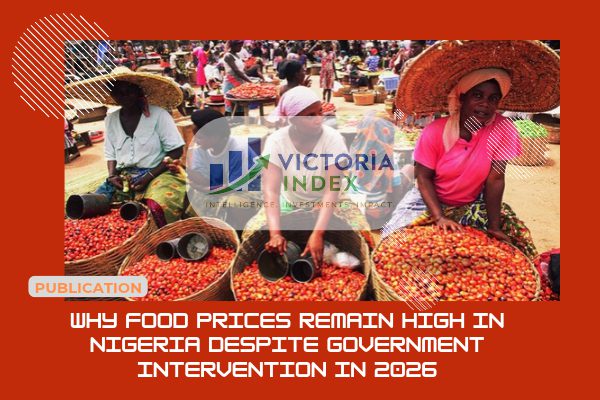
Food inflation is easing on paper, yet markets stay costly. Here is why government measures have not brought prices down.
Walk through any market in Lagos, Kano or Port Harcourt this month and the mood is mixed. Traders say some items are cheaper after the harvest, yet the weekly shopping bill still feels heavier than it did a year ago. The official figures explain why both things can be true. They also raise a harder question. The Federal Government has cut import duties, distributed fertiliser and promised relief, so why are food prices in Nigeria still so high?
This report by VictoriaIndex sets out what the latest National Bureau of Statistics (NBS) data actually show, what the government has done, and why its measures have not translated into the lower prices households expected. We have relied on NBS releases, central bank figures, official statements and published analysis. Where a claim comes from the government or a trade group, we say so.
The NBS reported on 15 October 2026 that headline inflation fell to 14.63% in September, down from 15.39% in August, the fourth straight monthly decline. Food inflation stood at 19.59% year on year, compared with 20.16% a year earlier. On a month-on-month basis, food prices actually fell by 1.55%, after rising 1.02% in August. You can find the underlying releases on the NBS website.
Those two numbers tell different stories, and mixing them up causes most of the confusion. Inflation measures how fast prices rise, not whether they fall. A food inflation rate of 19.59% means the average food basket costs nearly a fifth more than it did twelve months ago. The monthly fall means prices dipped slightly in September compared with August. Both can be true at once. For a clearer explanation of how the index is built, see our guide to Nigeria’s CPI rebasing and how it affects true inflation tracking.
The September dip also looks seasonal. The NBS named grains, rice, eggs, onions, palm oil, vegetables, potatoes, plantain and tomatoes among the items that fell, which fits a harvest period. VictoriaIndex’s research gathered that rural prices fell 0.89% month on month while urban prices rose 0.53%, because farmers sell at harvest and city dwellers still pay for transport, rent and power. It also pointed out that core inflation rose 1.11% month on month in September, and that energy prices climbed 5.38%. Food prices are not the only pressure on a household budget.
The pain is also uneven. Lagos, Imo and Ondo recorded the highest annual food inflation among states in September, according to NBS data as reported by Legit.ng, with Imo leading at 33.79%. Taraba and Yobe recorded negative rates. Where you live changes what you pay.
The Federal Government has pursued several measures since 2024. The table summarises the main ones and what the evidence investigate by VictoriaIndex says.
| Measure | What it did | What the evidence shows |
|---|---|---|
| 150-day duty-free import window (from July 2024) | Removed duties on items such as wheat, maize, rice and sorghum | Customs says N97 billion in duties were waived and credited the policy with price reductions; Daily Trust reported over N188 billion in lost revenue; analysts said prices stayed high |
| Tariff cut on rice (April 2026) | Reduced duty on bulk rice from 70% to 47.5% | A reduction, not a waiver, so it is a smaller relief than the earlier zero-duty period |
| Fertiliser and Guaranteed Price Model | Minister says over 10 million bags of fertiliser distributed and a price scheme for two million smallholders | Government-reported; independent results not yet published |
| Food palliatives | N9.74 billion spent in 2024, per BudgIT’s GovSpend data | One-off support, not a lasting price fix |
The Minister of Agriculture and Food Security, Abubakar Kyari, has said the interventions are working and that some essential commodities have recorded price reductions of up to 50%. The Customs Service has likewise said the duty exemptions contributed to food price falls. These are official claims. Critics note that they sit uneasily beside the year-on-year inflation figure.
Imports remain costly. Nigeria still leans heavily on imported grain. NBS reported food imports valued at about N7.65 trillion in 2025, and cited estimates that Nigeria imported about 10.1 million tonnes of grain in the 2025/2026 marketing year. Central Bank figures cited by Truth Nigeria put food import spending at $1.19 billion in the first half of 2026, up 11.41% year on year. Imported food prices rose 9.19% year on year in September, according to NBS-based calculations, even though that pace was the slowest since March. When the naira weakens or dollars are scarce, imports cost more, which is why exchange rates matter so much. We explain that link in our piece on Nigeria’s foreign reserves and their effect on the naira.
Moving food costs more. Energy and transport costs feed straight into food prices, because most produce travels long distances by road. The September rise in energy prices matters here. The US government’s Nigeria commercial guide has also linked food inflation to higher import prices, lower domestic production and higher fuel and transportation costs following the end of the fuel subsidy. It is available on the US Trade Administration site.
Insecurity keeps farmers off their land. Reports of violence in farming communities have contributed to lower local supply and higher dependence on imports. Farmers who cannot plant or harvest safely produce less, and what they produce costs more to move.
Credit is expensive. Farmers, processors and traders all borrow to operate. When interest rates rise, those costs show up on shelves. Our explainer on how the CBN interest rate hike affects everyday businesses shows how that works for small firms.
Agriculture is underfunded. The same US commercial guide notes that the government proposed spending 1.75% of the 2025 national budget on agriculture, far below the 10% target set in the Maputo Declaration. Long-term fixes such as irrigation, storage and rural roads need steady money.
Policy has been inconsistent. Duty waivers lowered import costs for a time, but they ended. The latest move was a tariff reduction, not a waiver, and a trade analyst quoted in the Guardian said this was a different and smaller form of relief. Short-term price relief followed by a return to higher duties can leave importers and consumers guessing.
There is a fair argument in the government’s favour. Headline inflation has fallen from 20.98% in September 2025 to 14.63% a year later, and the monthly food price decline suggests the harvest is helping. Fertiliser distribution and guaranteed pricing target the real problem, which is production. Supporters say these measures take time to show up in market prices.
Critics respond that the interventions have not changed the underlying picture. Government interventions and rising import bills had not translated into lower food prices. Observers interviewed by VictoriaIndex urged investment in irrigation, rural roads, storage, affordable credit and farmer security, rather than reliance on imports. The honest reading is that both sides have part of the story. Prices have stopped climbing as fast, but they have not come down to levels that most households find comfortable.
Incomes matter too. A price that looks stable can still be unaffordable if wages do not keep pace. We looked at that gap in our review of the purchasing power of the minimum wage in Nigeria, and at direct support in our report on the ₦50,000 monthly NERSI cash relief programme.
Some steps help at the margin. Buy staples when they are in season and cheapest, which right now means many grains and vegetables. Compare prices across markets, since the gap between states and even neighbourhoods is large. Buying in bulk with neighbours or family can cut per-unit costs, provided you can store the food safely. Cost of living also varies widely by location, which we covered in our list of the most affordable states to live in Nigeria.
Three signals will show whether the relief lasts. The first is the October inflation report, due in mid-November, which will show whether the harvest dip continues or fades. The second is the exchange rate and the level of foreign reserves, which drive import costs. The third is energy and transport prices, which can quickly erase the savings from a good harvest. Any changes to import tariffs will also matter.
Food prices in Nigeria remain high in 2026 because the forces behind them are larger than any single intervention. Import dependence, transport and energy costs, insecurity, credit costs and thin agricultural funding all push in the same direction, while duty cuts and fertiliser programmes push back. The September harvest brought a welcome monthly dip, but food is still nearly a fifth more expensive than a year ago. Until production rises, roads and storage improve and the naira stabilises, relief is likely to stay partial. VictoriaIndex will keep tracking the numbers and will update this report after the next inflation release.
Sources: National Bureau of Statistics (CPI, September 2026); Central Bank of Nigeria; US Trade Administration, Nigeria Agriculture Sector; Daily Trust on food sufficiency.
More from the Economy category: