Physical Address
Victory Est, Ogombo Ajah, Eti-Osa, Lekki 101245, Lagos
Physical Address
Victory Est, Ogombo Ajah, Eti-Osa, Lekki 101245, Lagos

Nigeria Financial News, Stock Market Data, Economy & Market Analysis
Nigeria Financial News, Stock Market Data, Economy & Market Analysis
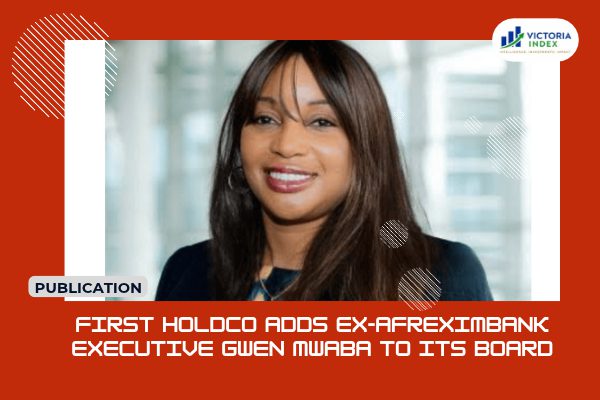
First HoldCo has named former Afreximbank executive Gwen Mwaba a non-executive director, effective October 15, 2026, after Central Bank approval.
First HoldCo Plc, the parent company of FirstBank, has appointed Gwen Mwaba, a former senior executive at the African Export-Import Bank (Afreximbank), as a Non-Executive Director. The appointment took effect on October 15, 2026, after approval from the Central Bank of Nigeria (CBN). The group told the Nigerian Exchange (NGX) and the investing public in a disclosure signed by its Group Secretary, Abiola Baruwa, and the news was widely reported in the days that followed.
Board appointments rarely move share prices, but they tell you a good deal about where a company thinks its risks and opportunities lie. For a banking group that has spent the past two years cleaning up its balance sheet and raising capital, a director with roughly three decades in trade finance and credit risk is a pointed choice. This report looks at who Mwaba is, what she brings, and why the timing matters for First HoldCo and its shareholders.
Mwaba is a Zambian banker who spent the last decade of her executive career at Afreximbank, the Cairo-based pan-African trade bank. According to Global Trade Review, she joined from Standard Bank, where she had been an executive vice president for structured trade finance and syndications for Africa, based in London. At Afreximbank she started in May 2015 as regional manager for Anglophone West Africa, running the bank’s Abuja branch office. She was appointed Director of Trade Finance in June 2016 and later rose to Managing Director of Trade Finance and Correspondent Banking.
In that last role she had executive responsibility for trade finance and structured credit activities across Africa and the Caribbean. Business Post reports that she oversaw a portfolio of exposures worth $19.5 billion spread across sovereigns, financial institutions and corporates. Her earlier career included senior roles at Stanbic Bank Zambia and Standard Bank South Africa, where she led vehicle and asset finance and corporate banking. At Standard Bank in London she handled complex commodity finance, export-credit-agency-backed facilities and pre-export financing across the continent.
Her qualifications, as listed in an Afreximbank management profile, include a Bachelor of Applied Accounting from Oxford Brookes University and an MBA from Heriot-Watt University in the United Kingdom.
Mwaba has also been active in the policy side of trade finance. Reports on her appointment say she served on the World Trade Organization-led Expert Group on Trade Finance and on the Multilateral Institutions Board Advisory Panel of the International Trade and Forfaiting Association (ITFA). She has also served on the editorial board of the publication Trade Treasury and Payments. More recently she has spoken publicly about the need to build African capacity in trade finance. In late 2025, at an Afreximbank trade finance seminar in Abidjan, she urged African financial institutions to strengthen their trade finance skills so they can cope with global shocks.
That public record is useful for readers who want to judge her credentials. It shows a banker who has both run transactions and shaped how regional lenders think about risk, which is the combination a board usually wants in a non-executive director.
The disclosure says the appointment follows CBN approval and complies with NGX Rulebook requirements. Press coverage of the announcement describes her expected contribution as strengthening the group’s credit risk framework, its approach to sovereign and institutional lending and the way it deploys capital. These are the media’s reading of the move, and the company’s notice itself is brief.
The filing does not, in the excerpts we reviewed, say which board committees she will join or whether she will sit as an independent director. Readers should watch for that detail in the group’s annual report, because committee roles show where her influence will be felt most, particularly on risk and credit.
To understand the appointment, you have to look at what First HoldCo has been through. The group’s audited 2025 results carried a large one-off impairment charge, reviewed by VictoriaIndex at N826.3 billion, as management cleared legacy bad loans from the books ahead of the banking recapitalisation. That decision depressed headline profit for the year but was presented as a way to start 2026 on a cleaner footing.
The turnaround since then has been sharp. For the first half of 2026, First HoldCo reported a pre-tax profit of N653.54 billion, up 83.5% from N356.15 billion a year earlier, on gross earnings of N1.93 trillion. Profit after tax rose 81.6% to N526.13 billion. The second quarter alone delivered a pre-tax profit of N332.42 billion, slightly ahead of the first quarter, which suggests the recovery was not a single-quarter event. The half-year figures are the latest we could confirm, and we will update this report when the nine-month results are published.
On the capital side, FirstBank told the NGX that it had met the CBN’s N500 billion minimum capital requirement for banks with international authorisation. You can read the group’s notification on the NGX document library. Shareholders then approved a raise of up to N253.1 billion at the 14th Annual General Meeting on May 29, 2026, as the group works toward a N1 trillion paid-up capital base. The group also completed a N45 billion tranche of a larger private placement in June. The CBN has since said the wider recapitalisation exercise has concluded, with 33 banks meeting the new requirements and N4.65 trillion raised across the sector.
A bank with an international licence and regional ambitions needs people who understand cross-border risk. Trade finance and correspondent banking sit at the centre of that work. They determine how easily a bank can confirm letters of credit, settle in foreign currency and build relationships with lenders abroad. Mwaba’s career is almost entirely in those areas.
Her background in sovereign and institutional exposure also matters for a group that has to manage large single-name risks and the lessons of its own loan book. Having someone on the board who has overseen a multi-billion-dollar book through shocks, including the pandemic and the Ukraine crisis she has discussed publicly, brings a useful outside view. The appointment also adds a woman with deep international experience to the board, though the company did not frame the move that way in its notice.
None of this guarantees better results. A non-executive director does not run the bank day to day, and her influence will show up mainly through oversight, challenge and committee work. The real test will be how risk reporting and credit decisions evolve over the next year.
Investors have rewarded the recovery. After the half-year results, shares rose 10% to N105.50, and they later reached a record of N140, taking market capitalisation to about N6.37 trillion on August 6, according to VictoriaIndex News reviews. That was a rise of roughly 192% from the 2025 close of N47.90. VictoriaIndex Research noted at the time that the July 20 close implied about nine times half-year earnings per share and about 1.3 times book value, which is a useful reminder that the stock had already moved a long way before this appointment.
For readers who want to place First HoldCo in the wider sector, our guide to the best banking stocks in Nigeria’s recapitalisation era compares the main names. Our explainer on market capitalisation and free float helps with reading figures like those above, and our look at the 2026 NGX rally covers the market backdrop. Shareholders waiting on payouts can also read our guide to dividend stocks on the NGX, since the group has said regulatory capital needs have taken priority over distributions.
Three things will tell us more. The first is the group’s nine-month results, which will show whether the earnings recovery has held through the third quarter. The second is the 2026 annual report, which should list board committee memberships and give a fuller account of how the board is changing. The third is progress on the capital plan, since the group still has fundraising to complete. Official updates appear on the Nigerian Exchange, and rules on director approvals and bank capital come from the Central Bank of Nigeria. For background on Mwaba’s former employer, see Afreximbank, and for the trade finance bodies she has worked with, see the International Trade and Forfaiting Association and the World Trade Organization.
First HoldCo’s appointment of Gwen Mwaba is a sensible governance move for a group that has repaired its balance sheet and now wants to grow across borders. Her record in trade finance, credit risk and correspondent banking fits that plan. It is too early to say how much difference one director will make, and the company has not yet said which committees she will join. For now, the appointment is best read as a signal of intent from a bank that wants stronger oversight as it rebuilds, and the next set of results will show whether the strategy is working.
Sources: First HoldCo’s disclosure to the NGX as reviewed by VictoriaIndex, Business Post, Arbiterz and WorldStage; Global Trade Review on Mwaba’s earlier career; Afreximbank management profile; First HoldCo’s notification on the CBN capital requirement.
Editorial note: This article is for information only and is not investment advice. Please read our Financial Disclaimer and Editorial Policy.