Physical Address
Victory Est, Ogombo Ajah, Eti-Osa, Lekki 101245, Lagos
Physical Address
Victory Est, Ogombo Ajah, Eti-Osa, Lekki 101245, Lagos

Nigeria Financial News, Stock Market Data, Economy & Market Analysis
Nigeria Financial News, Stock Market Data, Economy & Market Analysis
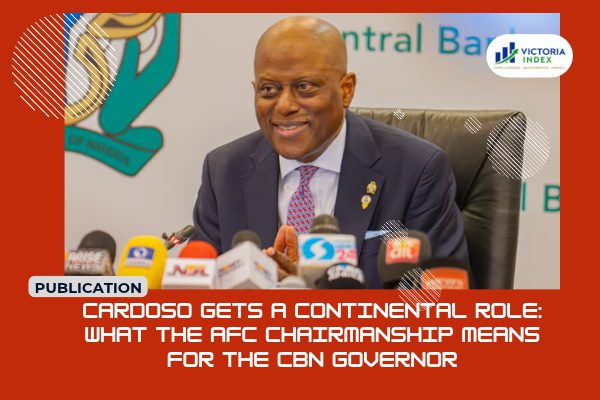
Cardoso AFC chairman appointment explained: what the CBN governor's new role at Africa Finance Corporation means for Nigeria and investors.
Olayemi Cardoso, the Governor of the Central Bank of Nigeria (CBN), has been appointed Chairman of the Board of Directors of the Africa Finance Corporation (AFC), adding a continental leadership role to his duties at the apex bank. The Lagos-headquartered infrastructure financier announced the decision on 14 October 2026. Cardoso succeeds Ireti Samuel-Ogbu, who chaired the board from April 2025 and remains a member of it.
The appointment has drawn attention in Nigerian financial circles for two reasons. It places the person who sets the country’s monetary policy at the head of one of Africa’s most active infrastructure lenders, and it extends a long line of Nigerian chairs at the institution. VictoriaIndex reviewed the AFC’s announcement and related reports to explain who Cardoso is, what the AFC does, and what the role could mean for the CBN, for Nigerian businesses and for investors.
According to the corporation’s statement, Cardoso brings experience spanning international banking, investment management, economic policy and public sector leadership. AFC said that since taking office as CBN Governor in September 2023, he has led a programme of monetary, financial-sector and institutional reforms aimed at restoring macroeconomic stability, strengthening policy credibility and rebuilding investor confidence.
The statement credited the CBN under his leadership with reforms to the foreign exchange market, steps to address longstanding foreign exchange obligations, stronger monetary policy transmission and better institutional governance and transparency. It also noted that the bank has concluded its recapitalisation programme for the banking sector.
Samaila Zubairu, AFC’s President and Chief Executive Officer, said Cardoso shares the corporation’s conviction that Africa’s lasting stability depends on its productive capacity. Cardoso, in his response, said a more productive Africa is a more stable Africa, and that the measure of success must be the productive capacity created, the industries enabled and the jobs supported. Both referred to The Africa We Build 2050, the corporation’s long-term agenda.
Before joining the CBN, Cardoso spent 12 years as Chairman of Citibank Nigeria. He also served as Commissioner for Economic Planning and Budget in Lagos State, where he contributed to economic planning and fiscal management in one of Africa’s largest sub-national economies. He holds a degree from Aston University in the United Kingdom and a master’s degree in public administration from the Harvard Kennedy School, where he also served on the Alumni Board.
His record at the CBN has been closely watched. Under his leadership, the central bank unified and reformed the foreign exchange market and, on 22 September 2026, cut the Monetary Policy Rate by 350 basis points from 26.5% to 23%. The CBN’s Monetary Policy Committee decisions page records the sequence of rate decisions over recent years. For readers who want to understand how these decisions reach household finances, VictoriaIndex has explained how CBN policies affect your money and investments.
The Africa Finance Corporation is a multilateral development finance institution established in 2007 to mobilise capital for infrastructure development and industrialisation across Africa. It finances and develops projects in power, transport, natural resources, telecommunications and heavy industry, and it describes itself as the continent’s leading infrastructure solutions provider. More about its mandate and portfolio is available on the AFC website.
The corporation’s own announcement pointed to three recent milestones. It reached financial close on the US$753 million Lobito Corridor Railway Project in Angola, which supports the rehabilitation, upgrade and long-term operation of a 1,300-kilometre rail corridor. It is backing a US$600 million facility for Dangote Group’s US$7 billion fertiliser expansion programme in Nigeria. It has also committed a combined US$300 million, alongside Vision Invest, to WIOCC Group to expand digital infrastructure across the continent.
Those examples show why a chair with a background in banking reform and capital markets matters. AFC raises money from investors and lenders around the world, so credibility with financial markets is part of the job.
Cardoso is the latest in an unbroken line of Nigerian board chairs at AFC. Reports on the appointment describe him as the sixth Nigerian to hold the position since 2007. The first chairman was Charles Soludo, who was CBN Governor from 2004 to 2009. Three later chairs, Sarah Alade, Joseph Nnanna and Kingsley Obiora, all served as CBN deputy governors. That makes Cardoso the second substantive CBN governor to chair the corporation, after Soludo.
The link is not just historical. AFC is headquartered in Lagos, and the CBN is among its institutional shareholders. A chair drawn from the central bank therefore connects two institutions that already have formal ties.
An AFC chairmanship is a non-executive board role. It does not change the CBN’s mandate, the composition of its Monetary Policy Committee or its policy framework. Cardoso remains accountable to Nigerian law and to the CBN’s own governance structure.
Even so, the appointment is worth watching on several fronts. The first is reputation. Heading a respected pan-African institution reflects how external financial institutions view the CBN’s recent reform record, and it may strengthen Nigeria’s voice in discussions about financing African infrastructure. The second is time and attention. A governor who also chairs a major board must balance both calendars during a period when monetary policy is changing quickly, with inflation easing and interest rates being reset. The third is governance. Because the CBN is a shareholder in AFC, observers may look for clear arrangements on how any dealings between the two institutions are handled. Those are matters for the institutions themselves, and no concern has been raised in the announcement. They are simply points a careful reader will want to follow.
For companies planning large projects, AFC is a source of long-term funding that is often hard to find from commercial banks alone. The Dangote fertiliser facility is a direct example of the corporation financing a Nigerian industrial project. A board chaired by a Nigerian with deep ties to the domestic financial system could help keep Nigeria’s infrastructure and industrialisation needs prominent in the corporation’s thinking, though board decisions are collective and AFC’s investments are guided by its own credit and risk processes.
For investors, the more immediate effect is indirect. Stronger infrastructure financing supports sectors such as power, transport and manufacturing, which feed into the earnings of listed companies. VictoriaIndex’s report on Nigerian companies expanding across Africa looks at how local firms are building regional footprints, a trend that benefits from better cross-border infrastructure. The appointment does not by itself move interest rates, the exchange rate or share prices. Those are driven by inflation data, policy decisions and market conditions. The National Bureau of Statistics publishes the official inflation and consumer price data that shape those decisions, and VictoriaIndex’s analysis asks whether inflation will drop in Nigeria in 2026.
Readers interested in how government and public borrowing fit alongside development finance can also read VictoriaIndex’s explainer on Nigeria’s debt profile and the difference between external and domestic borrowing.
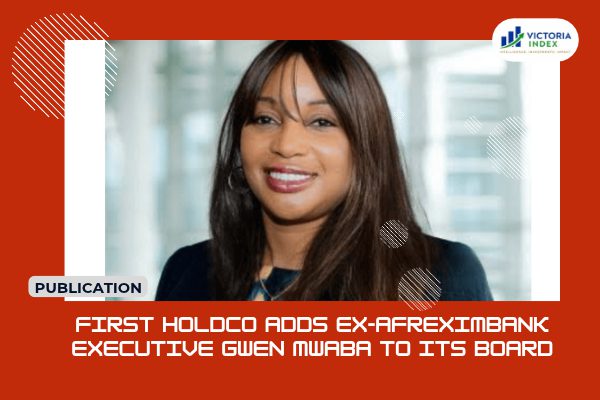
The Cardoso announcement is one of several senior appointments in Nigerian finance in recent weeks. VictoriaIndex has also reported on Access Bank’s two senior executive appointments, First HoldCo’s addition of Gwen Mwaba to its board and Dapo Olagunju’s move to lead JPMorgan Nigeria. Together they show how leadership changes are reshaping both banks and the institutions that finance the wider economy.
Several developments will show how the appointment plays out. AFC may publish further details on how the new chair will work with the board and management. The corporation’s next financing announcements will indicate how its priorities evolve under the new chair. For Cardoso, the key tests remain at home: keeping inflation on a downward path, maintaining stability in the foreign exchange market and ensuring that recent rate cuts reach borrowers and savers.
Official information on the CBN’s decisions and publications is available on the Central Bank of Nigeria website, and the corporation’s announcements appear on the AFC website. VictoriaIndex will continue to report on appointments and policy developments that affect Nigeria’s financial system.
Olayemi Cardoso’s appointment as Chairman of the Africa Finance Corporation adds a continental role to his position as CBN Governor and continues a long Nigerian presence at the head of the institution. The role is non-executive, so it does not change monetary policy, but it does raise Nigeria’s profile in African infrastructure finance. How well he balances both responsibilities, and how clearly the two institutions handle their shared interests, will determine whether the appointment is remembered as a strength for Nigeria’s financial leadership.
Disclaimer: This article is for information only and does not constitute investment advice. Details are based on the Africa Finance Corporation’s announcement of 14 October 2026 and related public reports.