Physical Address
Victory Est, Ogombo Ajah, Eti-Osa, Lekki 101245, Lagos
Physical Address
Victory Est, Ogombo Ajah, Eti-Osa, Lekki 101245, Lagos
Nigeria Financial News, Stock Market Data, Economy & Market Analysis
Nigeria Financial News, Stock Market Data, Economy & Market Analysis
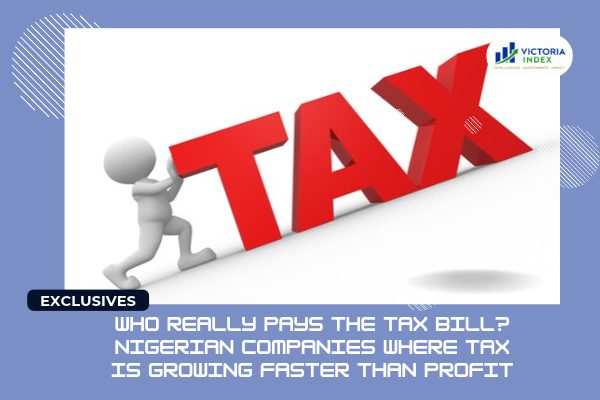
Tax charges on Nigerian companies rose almost twice as fast as profit in 2026. We show who is paying most.
Open the nine-month results of a listed Nigerian company this season and the first number most people check is profit before tax. The second should be the tax line. For a large share of NGX companies, tax has grown far faster than profit in 2026, and in a few cases it has turned a healthy pre-tax gain into a smaller profit for shareholders. This VictoriaIndex analysis looks at who is paying the most, why the bill has jumped, and which parts of the increase are permanent and which are not.
We started from the unaudited nine-month statements that companies filed with the Nigerian Exchange, then compared tax expense with pre-tax profit for each company. Our own earlier reports on GTCO and Zenith Bank supplied the bank numbers, and published compilations of 41 listed companies supplied the wider picture. We calculated effective tax rates ourselves where a company did not state one. The effective tax rate is simply income tax expense divided by profit before tax, so a company paying N27 on every N100 of pre-tax profit has a rate of 27%.
One caution before the numbers. These are interim accounts, and companies usually estimate interim tax at the rate they expect for the full year. The final figures could move by December.
Across 41 NGX-listed companies, income tax expense for the nine months to September 2026 reached N4.52 trillion, up 71% from N2.65 trillion a year earlier. Their combined pre-tax profit reached N11.88 trillion, up 36%. Put simply, the tax bill grew about twice as fast as the earnings it was charged on, and the combined effective rate climbed from 30.3% to 38.1%.
That headline is distorted by a few oil and gas names. Aradel Holdings alone saw its tax charge rise from N55.6 billion to N721.4 billion after it consolidated acquired onshore assets, which accounts for about a third of the total increase. When Aradel, Seplat Energy and MTN Nigeria are removed, the remaining 38 companies still paid 51% more tax, N2.82 trillion, on pre-tax profit that grew 29%, and their effective rate rose from 24.6% to 28.8%. So the squeeze is real even without the outliers.
The Nigeria Tax Act 2025 took effect from January 2026. It kept the 30% corporate income tax rate for large companies, but it added a 4% development levy on assessable profits, which replaced several older levies, and a 15% minimum effective tax rate for companies with turnover of N50 billion or more. You can read the details in PwC’s Nigeria corporate tax summary.
The law explains only part of the jump, though. Some of the increase comes from higher profits, some from acquisitions, and some from catch-up charges for earlier years. Separating these is the real work, and it is why a single headline number can mislead.
| Company | Pre-tax profit change | Tax expense change | Effective rate now (last year) |
|---|---|---|---|
| Zenith Bank | Up 1.2% | Up 65% | 27.2% (16.7%) |
| GTCO | Down 2.3% | Up 32% | 30.2% (22.3%) |
| Dangote Cement | Up 41.5% | Up 67% | 33.8% (28.6%) |
| International Breweries | Up 22% | Not stated | 39.7% (22.1%) |
| Nestle Nigeria | Not stated | Not stated | 46.7% (43.4%) |
| MTN Nigeria | Up 59% | Up 68% | Not stated |
| First HoldCo | Up 61% | Up 54% | 18.3% (lower than before) |
Six banks and financial holding companies saw tax rise 40.5% to N1.06 trillion while pre-tax profit rose 15.9%. Their combined effective rate moved from 21.8% to 26.4%. The minimum tax is most visible here, because large lenders with low effective rates are exactly the ones a 15% floor catches.
Zenith Bank is the sharpest example. Pre-tax profit rose a thin 1.2% to N928.8 billion, but tax expense jumped 65% to N253 billion, and profit after tax fell 11.6% to N675.8 billion. Had Zenith kept last year’s 16.7% effective rate, the charge would have been roughly N155 billion by our calculation, which is about N98 billion lower. Of that gap, N89.9 billion is tax under-provided in earlier periods, which has nothing to do with the new law. The charge also includes N65.9 billion of minimum tax and N9.9 billion of development levy. So most of Zenith’s extra tax is a one-time catch-up plus new levies, and not a permanent rise in the underlying rate.
GTCO tells a different story. Pre-tax profit slipped 2.3% to N879.9 billion while tax rose about 32% to N265.3 billion, pushing the effective rate from roughly 22.3% to 30.2%. The bank pointed to changes in Companies Income Tax rules that reduced capital allowance reliefs, which raises taxable profit. On last year’s rate the bill would have been near N196 billion, so we estimate the rule changes cost the bank about N69 billion this period, and profit after tax fell about 12% to N614.6 billion. Unlike Zenith’s catch-up, this effect looks more likely to repeat.
First HoldCo is the exception. Pre-tax profit rose 61% and tax rose 54%, which pulled its effective rate down to 18.3%. A lower rate helped it turn a big pre-tax gain into an even bigger after-tax one. For the full bank ranking, see our report on Nigeria’s biggest banks by nine-month pre-tax profit.
Dangote Cement’s pre-tax profit rose 41.5%, yet its tax grew faster, up 67% to N497.7 billion, which lifted its group rate from 28.6% to 33.8%. This figure covers operations in Nigeria and other African markets, so some of the increase may come from outside the country.
International Breweries is a clear case of tax eating growth. Its pre-tax profit rose 22%, but its effective rate jumped from 22.1% to 39.7%, and profit after tax actually fell 6%. Nestle Nigeria already paid a high rate, and it rose again from 43.4% to 46.7%. Across seven consumer goods companies, tax rose 47% against 24% pre-tax profit growth.
BUA Foods reported tax of about N30.1 billion on pre-tax profit of N480.5 billion, an effective rate near 6.3%. That sits well below both the 30% headline rate and the 15% minimum, and analysts have noted it is not yet clear how the floor applies to it. We do not draw a conclusion, but it is the kind of number that invites a question from investors and from the tax authorities.
Seplat Energy shows an effective rate of 74%, down from 83%, but its numbers are driven by petroleum industry tax rules, with hydrocarbon tax at 60% on onshore assets, so it should not be compared with banks or manufacturers.
Expense is an accounting figure. Cash is what actually leaves the bank account. Thirty companies that disclosed cash tax for both periods paid N3.02 trillion in the first nine months of 2026, up 85% from N1.64 trillion. Much of this relates to earlier-year liabilities, so the full cash effect of 2026 profits may only show up in 2027 when those liabilities are settled. That could tighten cash for dividends and expansion plans.
First, compare profit before tax and profit after tax together. A company can post strong pre-tax growth and still deliver weak earnings per share, as International Breweries did. Our guide to analysing an NGX corporate earnings report shows where to find the tax note.
Second, ask whether the extra tax is a one-off or a new normal. Zenith’s under-provision should not repeat, while the development levy and the loss of capital allowance relief probably will. Third, watch payouts, because after-tax profit is what funds dividends, and our explainer on how NGX dividends work covers payout ratios and qualification dates. For wider context on bank strength, read our exclusives on the hidden financial risks facing Nigerian banks and the bank recapitalisation story, and see how companies that swung from loss to profit in 9M 2026 fared on tax. Our wider corporate earnings analysis shows which firms are winning on core performance.
Profit growth in 2026 is not reaching shareholders at the same speed. For the 38 companies outside the oil producers, tax is growing roughly 1.8 times as fast as pre-tax profit, banks are being hit hardest by the minimum rate and by lost reliefs, and some consumer names are watching tax absorb their gains. Part of the increase is one-off and part is permanent, so the year-end audited accounts will matter more than any interim headline. Until then, read the tax line before you read the headline.
Disclaimer: This article is for information only and is not tax, legal or investment advice. Figures come from companies’ unaudited filings and effective rates marked as our calculation are estimates. Please read our financial disclaimer before making any decision.