Physical Address
Victory Est, Ogombo Ajah, Eti-Osa, Lekki 101245, Lagos
Physical Address
Victory Est, Ogombo Ajah, Eti-Osa, Lekki 101245, Lagos
Nigeria Financial News, Stock Market Data, Economy & Market Analysis
Nigeria Financial News, Stock Market Data, Economy & Market Analysis
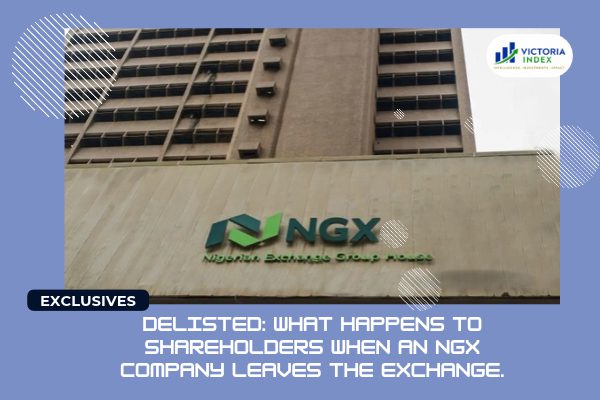
When an NGX company delists, you keep your shares but lose the market. Know what happens and what to do.
Most Nigerian investors spend their energy on one question: which shares to buy. Far fewer ask the harder one, which is what happens to my money if the company is removed from the exchange. The question is no longer theoretical. Eight companies left the Nigerian Exchange in 2025, two more were delisted in April 2026, and nine more are currently on the exchange’s watchlist or in restructuring. This VictoriaIndex analysis explains how delisting works, what shareholders keep, what they lose, and the practical steps worth taking before a notice lands.
Delisting does not mean the company has collapsed, and it does not cancel your shares. A Legal500 analysis of the topic puts it plainly: delisting is not the same as winding up. You remain a legal owner of the company. What disappears is the exchange-traded market, the place where you could sell quickly at a visible price. That loss of liquidity is the real damage, and it is why a delisting can hurt even when the business carries on.
The NGX describes two main routes in its own delisting process document. They affect shareholders very differently.
Voluntary delisting starts with the company. The board passes a resolution, the draft meeting notice is vetted by the NGX, and the notice must run in at least two national dailies at least 21 days before the shareholders’ meeting. An NGX representative attends. The resolution needs a simple majority of members present in person or by proxy. Shareholders who do not want to stay in an unlisted company must be offered an exit. The majority shareholder or core investor has to set aside enough money to buy them out, held with an exchange-approved custodian such as CSCS, and the price cannot be lower than the highest price the shares traded at in the six months before the meeting.
Regulatory delisting is the severe route. It is a sanction for persistent failure to meet listing obligations. The exchange’s listings department recommends removal with reasons, the company is told that delisting is under consideration, the relevant committee approves it, and the market is informed. The NGX’s description of this route includes no exit offer, and that is the key difference. In a regulatory removal, shareholders should not expect to be bought out.
MRS Oil Nigeria (voluntary). The board set an exit price of N135 per share, described as the minimum the NGX requires. Only shareholders who dissented and chose to exit had to complete an election form within a fixed window, and payment was made by bank transfer from funds held in custody. The company stays a public limited company so that its shares can be traded on the NASD OTC Securities Exchange, under SEC rules for unlisted securities. It cited the need for more flexibility and lower compliance costs.
Notore Chemical Industries (voluntary). The NGX suspended trading from a market bulletin dated June 11, 2025, and delisted the shares on July 4, 2025. Notore had listed about 1.612 billion shares in August 2018 at N62.50 each, and the price stayed at that level until delisting. The company said the move would support internal restructuring, debt management and operational realignment, after an offer from core shareholders to buy out minority holders.
Medview Airline, Capital Oil, Tourist Company of Nigeria and others (regulatory). Six of the eight 2025 delistings were forced by the exchange, which said these companies were operating below listing standards. Medview’s share price had not moved above or below N1.62 in two years, a sign of how illiquid such shares can become well before the end.
DN Tyre and Greif Nigeria (April 2026). The NGX delisted both on April 9, 2026. DN Tyre had been classed as a restructuring company since 2018 and had been given repeated extensions over more than 12 years without fixing its compliance problems. Greif had completed its formal liquidation in November 2025, so its delisting was a procedural step, and shareholders may have to wait for any residual value. Reports described DN Tyre holders as facing an investment gone irredeemably bad.
You keep legal ownership, and you keep rights under the Companies and Allied Matters Act 2020. As summarised by Legal500, these include the right to inspect books, receive audited accounts and vote at general meetings. They also include the right to sue for a declared dividend that has not been paid (section 432), the right to petition the court if the company is run in an oppressive or unfairly prejudicial way (sections 353 to 356), and the right to seek a winding up on just and equitable grounds (section 571).
What you lose is easy exit. Selling now means finding a buyer on the NASD OTC market, arranging a private transfer within whatever the company’s articles allow, or accepting a buyback if one is offered. For distressed companies those options are often weak, with little buyer interest and unclear pricing. And if the company is liquidated, shareholders rank last, behind secured, preferential and unsecured creditors, which for an insolvent company usually means nothing is left.
The NGX’s X-Compliance Report of October 23, 2026 flagged nine companies. Four sit on the delisting watchlist: Union Dicon Salt, Critical Minerals Financing Corporation, Multi-Trex Integrated Foods and Fortis Global Insurance. Five more, FTN Cocoa Processors, Thomas Wyatt Nigeria, Austin Laz and Company, Pharma-Deko and Premier Paints, are undergoing restructuring.
Being on the list does not automatically lead to delisting. Union Dicon, for example, has fixed its free float shortfall but must complete its business restructuring by November 2026, a review point, not a confirmed removal date. Fortis Global Insurance was approved in February 2025 for three years, the longest period of the four. We name these companies for information only and draw no conclusion about their outcomes.
First, read every exchange notice and every notice of a shareholders’ meeting. If the company wants to delist, your vote and the election deadline for the exit offer matter. In the MRS Oil case, the window to elect for the exit price was short, so missing it is a costly mistake.
Second, compare any exit price with what you paid and with the six-month high that sets the floor. The floor protects you from a very low offer, but it does not guarantee a fair one.
Third, keep your records in order. Confirm that your registrar details, bank account and CSCS information are current, and keep contract notes and certificates. Unclaimed dividends and unreachable shareholders are a common headache. Our guide to how NGX dividends work explains how to claim what is owed.
Fourth, if the shares move to the NASD OTC market, check how that market works and who the dealers are before you trade. Make sure any platform you use is registered with the Securities and Exchange Commission.
Fifth, if you believe minority shareholders are being treated unfairly, speak to a lawyer who handles company disputes. The statutory remedies exist, but they are not self-executing.
Delistings rarely arrive without warning. The usual signs are late financial filings, repeated queries from the exchange, a share price that barely moves, thin trading and a free float below the listing requirement. Our explainer on market capitalisation and free float shows why float matters, and our guide on how to analyse an NGX earnings report covers the filing checks. For the other side of the picture, read how companies list on the NGX and what can go wrong, our corporate earnings analysis, our look at the NGX boom and the plan to list state-owned enterprises. Our exclusive on rising tax bills at listed companies shows another pressure on weaker balance sheets.
A delisting is not the end of your ownership, but it can be the end of your ability to sell. Voluntary exits usually come with a buyout offer at a protected minimum price, while regulatory removals offer no such cushion. The safest habit is to treat the exchange’s compliance notices as part of your research, to act inside every deadline, and to remember that a share which has stopped trading is rarely worth what its last price says. Read the filings, watch the warning signs and keep your records ready.
Disclaimer: This article is for information only and is not legal, tax or investment advice. Delisting rules and company circumstances change, and some details come from published reports and law firm commentary. Please verify with the NGX and the SEC, speak to your stockbroker before investing, and read our financial disclaimer before making any decision.