Physical Address
Victory Est, Ogombo Ajah, Eti-Osa, Lekki 101245, Lagos
Physical Address
Victory Est, Ogombo Ajah, Eti-Osa, Lekki 101245, Lagos
Nigeria Financial News, Stock Market Data, Economy & Market Analysis
Nigeria Financial News, Stock Market Data, Economy & Market Analysis
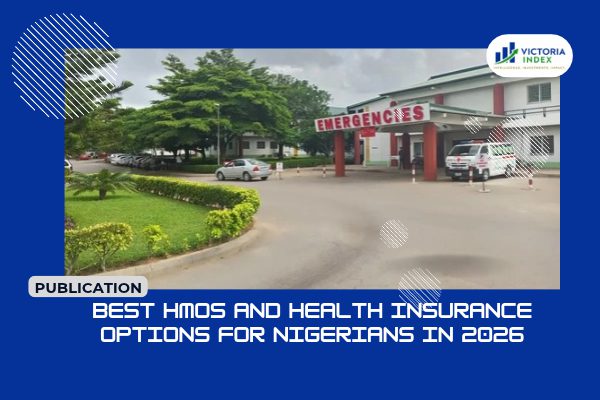
Best HMOs in Nigeria 2026: compare NHIA-accredited plans, costs, hospital networks and benefits to choose health insurance that fits you.
A hospital bill can undo years of careful saving in a few days. For many Nigerian households, health costs are still paid directly from pocket, which means a surgery, a difficult delivery or a long illness can force families to borrow, sell assets or delay treatment. Health insurance exists to spread that risk, and a Health Maintenance Organisation (HMO) is the company that makes it work for most private plan holders.
Choosing the best HMO in Nigeria is harder than it looks. There are dozens of accredited providers, premiums have risen sharply in recent years, and a cheap plan with a poor hospital network can cost more in frustration than it saves in cash. This VictoriaIndex guide explains how HMOs work, the public and private routes to cover, what the plans cost, which HMOs are most often named in 2026 comparisons, and how to judge a plan before paying for it.
An HMO is a company accredited by the National Health Insurance Authority (NHIA) to collect premiums from members and pay for their care at an agreed network of hospitals, clinics and pharmacies. When you fall ill, you go to your assigned or approved facility, the hospital treats you, and the HMO settles the bill within the limits of your plan.
The legal framework changed in 2022. The NHIA Act, signed in May 2022, replaced the old National Health Insurance Scheme with the National Health Insurance Authority, which regulates the sector, accredits HMOs and oversees public programmes. The law frames health insurance as mandatory for Nigerians, although enforcement is still being built up. Readers can find the authority’s official information on the NHIA website.
Separately, the insurance companies that underwrite other types of cover, and some HMO parent groups, are regulated by the National Insurance Commission (NAICOM). The first question to ask any provider is therefore simple. Is this HMO currently accredited by the NHIA? Reports in 2025 and 2026 put the number of accredited HMOs at somewhere between 70 and 83, and the list changes after periodic reviews, so always confirm on the NHIA’s official channels before you pay.
There is more than one way into the system, and the right one depends on your work and income.
Formal sector cover. Employees of companies with five or more staff are expected to be enrolled through their employer under the Organised Private Sector Social Health Insurance Programme. The employer registers the business with an accredited HMO, and premiums are usually shared between employer and employee through payroll. If you are salaried, check what your employer already provides before buying anything extra.
Individual and family cover. The Group, Individual and Family Social Health Insurance Programme serves self-employed people, informal workers and families outside formal employment. You choose an accredited HMO and a primary healthcare provider, and you can usually add a spouse and up to four biological children under 18. VictoriaIndex’s guide on retirement planning for self-employed Nigerians explains why people without an employer must build their own financial safety nets, and health cover belongs at the top of that list.
State schemes. State health insurance agencies in places such as Lagos, Oyo and Anambra run residence-based schemes, with contributions and benefits that vary by state.
Vulnerable group cover. Poor and vulnerable people, including pregnant women and children under five, are meant to be covered through government funding, at no cost to them.
Private plans. Many HMOs also sell private plans with wider hospital networks, higher limits and extras such as dental, optical and international referral. These are separate commercial products, but the HMO selling them must still be NHIA-accredited.
Premiums vary by HMO, plan tier, location, age and the number of dependants, so no single price applies nationwide. Comparison websites that track the market report entry-level individual plans starting from roughly N45,000 to N60,000 a year, family plans from about N80,000 to N150,000, and wider-network premium tiers of N150,000 to N400,000 or more. Some micro-plans for low-income workers are reported from as little as N12,000 a year. These are indicative figures only, and they should be confirmed directly with the HMO.
Prices have risen. Industry reports describe premiums climbing sharply between 2024 and 2025, driven by higher drug prices and hospital costs, and that pressure is still part of the pricing picture. VictoriaIndex’s analysis of why the rising cost of credit is changing how Nigerians borrow in 2026 shows how expensive it is to finance an emergency on credit, which is one more reason to insure the risk in advance. A premium that looks high in January often looks small against a single month of private hospital fees.
Two practical savings tips are widely reported. Many HMOs discount annual payment compared with paying monthly, and family plans are usually cheaper per head than buying separate individual plans. Neither discount is guaranteed, so ask.
There is no official league table of the best HMOs in Nigeria, and independent rankings use different methods. What can be said is that several providers appear repeatedly in 2026 comparisons of retail plans. These include Hygeia HMO, AXA Mansard Health, Avon HMO, Leadway Health, Reliance HMO, Hallmark HMO and Sunu Health. Each is described in various reviews as NHIA-accredited, and each has a different strength, such as network breadth, digital tools, corporate experience or affordability at the entry level.
VictoriaIndex does not rank these providers or recommend one over another. Reviews on comparison sites are commercial products, and some providers pay to be listed. A more reliable approach is to judge any HMO against a fixed set of tests, set out below, and to rely on your own experience and that of people you trust.
Accreditation. Check that the HMO is accredited by the NHIA and in good standing. An unaccredited provider may not satisfy the law and may leave you without valid cover.
Hospital network near you. A famous network is useless if the covered hospitals are far from your home or work. List the hospitals you would actually use, and confirm that each one is in the plan.
Benefit limits. Look at annual limits per person and per family, and any caps on surgery, maternity, chemotherapy, dialysis and drugs. A low overall limit can run out in one serious illness.
Exclusions and waiting periods. Ask which conditions are excluded, and how long you must wait before benefits such as maternity or pre-existing conditions begin.
Claims and pre-authorisation. Many plans need the HMO’s approval before specialist treatment or admission. Ask how fast approvals usually come and how complaints are handled.
Service quality. Check how easy the HMO is to reach, whether there is a working app or call centre, and what current members say about delays.
Renewal terms. Ask whether premiums can rise at renewal and by how much, and whether your plan can be switched without losing waiting-period credit.
Total cost. Compare the full annual cost, including any co-payments, card fees and add-ons, not just the headline premium.
For a salaried worker, the starting point is the plan your employer already provides. Find out the HMO, the assigned hospital and what is covered, then decide whether a top-up is worthwhile for your spouse or children.
For a self-employed person or freelancer, an individual or family plan through an accredited HMO is the main route. A basic plan with a trusted hospital nearby is usually better than a premium plan you cannot afford to renew.
For a family with children, benefit limits for maternity, paediatric care and drugs matter more than extras such as optical or dental cover. For older adults, chronic condition support and drug benefits deserve the closest attention.
For a small business owner, group plans for staff can be cheaper per head and can help retain workers. Any employer with five or more staff should also confirm its legal obligations under the NHIA Act.
Paying before checking accreditation is the most serious error. Others include choosing purely on price, assuming everything is covered, skipping the benefit schedule, ignoring waiting periods, failing to match names and National Identification Numbers across documents, and forgetting to renew on time. A lapse can mean losing continuity of cover or having to restart waiting periods.
It also helps to keep records. Save your enrolment confirmation, premium receipts, plan document and the HMO’s contact details, and note any pre-authorisation code given for treatment.
Health insurance premiums are part of a wider cost-of-living picture. The National Bureau of Statistics publishes official inflation and consumer price data that show how prices of goods and services, including health-related items, are moving. When inflation eases, premium growth should in theory slow, but providers set prices individually, so comparison shopping at each renewal remains worthwhile.
For more on the health system and public health policy, the Federal Ministry of Health publishes information on its official website.
The best HMO in Nigeria is the one that is accredited, close to the hospitals you will actually use, clear about its limits and exclusions, and affordable enough to keep for the long term. Start with your work situation to find the right route, verify accreditation with the NHIA, compare at least three providers using the tests above, and read the benefit schedule before you pay. Insurance cannot prevent illness, but a well-chosen plan can stop one illness from becoming a financial crisis.
Disclaimer: This article is for general information only and is not medical, legal or financial advice. Premiums, benefits, waiting periods, exclusions and enrolment rules differ by HMO and plan and change over time. Figures quoted are indicative and drawn from public comparison reports. Verify all details with the HMO and the National Health Insurance Authority before enrolling.