Physical Address
Victory Est, Ogombo Ajah, Eti-Osa, Lekki 101245, Lagos
Physical Address
Victory Est, Ogombo Ajah, Eti-Osa, Lekki 101245, Lagos

Nigeria Financial News, Stock Market Data, Economy & Market Analysis
Nigeria Financial News, Stock Market Data, Economy & Market Analysis
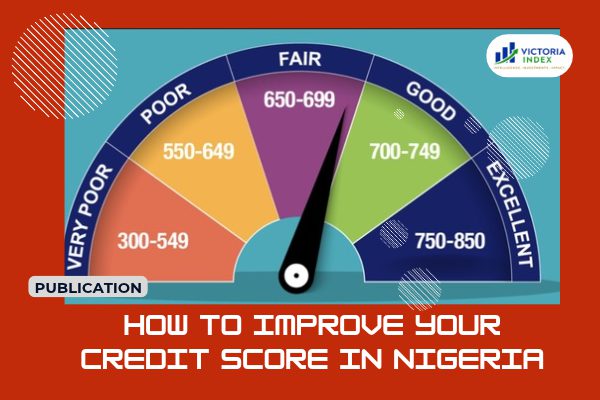
How to improve your credit score in Nigeria: check your report, pay on time, fix errors and avoid costly scams.
A few years ago, many Nigerians had never heard of a credit score. Today it can decide whether a bank approves a loan, what interest rate you are offered, and whether a lender asks for collateral or a guarantor. The score is built from your borrowing and repayment history, and unlike your salary or savings, it follows you from lender to lender.
The good news is that a credit score is not fixed. With the right habits, it can improve, although it takes months and not days. This VictoriaIndex guide explains what a credit score is, how Nigeria’s credit bureaus work, how to get your free report, the steps that raise your score, and the mistakes and scams to avoid.
A credit score is a number, in Nigeria typically between 300 and 850, that estimates how likely you are to repay borrowed money. It is calculated by a licensed credit bureau using the information lenders report about you. A higher score signals lower risk, and a lower score signals higher risk. Each bureau publishes its own score bands, so check how the one you use defines good and poor.
The score is only one part of a lender’s decision. Banks and fintech lenders also look at income, existing debts and the purpose of the loan. A strong score does not guarantee approval, and a weak one does not always mean refusal, but it influences both the answer and the price. VictoriaIndex’s analysis of why the rising cost of credit is changing how Nigerians borrow in 2026 shows why a better score matters when interest rates are high, since a lower perceived risk can mean cheaper credit.
Credit bureaus collect and store information on individuals and businesses who have borrowed. The Central Bank of Nigeria (CBN) licenses them and requires banks and other lenders to report customer credit information to licensed bureaus. The main names you will see are CRC Credit Bureau, CreditRegistry and FirstCentral Credit Bureau. The Central Bank of Nigeria publishes the rules for the sector.
A report usually lists the loans and credit accounts in your name, the amounts borrowed and owed, your payment history, any defaults or arrears, and personal details used to identify you. Reports and scores can differ between bureaus because lenders do not always report to all of them.
Coverage is still limited. A recent report on lender reporting, citing a CBN survey, noted that only around 13% of the population is covered by credit bureaus, and that defaults had risen across secured and unsecured loans. Many Nigerians therefore have thin or no credit files, and those who borrow responsibly can stand out.
Start by finding out where you stand. CRC states that you are entitled to one free credit report every year, and the same rule is widely reported for the other bureaus. Additional reports usually carry a fee, which varies by bureau, so check the price before paying.
When your report arrives, read it line by line. Check that your name, date of birth, phone number and other details are correct, that every loan listed is really yours, that balances and payment histories are accurate, and that settled loans are marked as settled. Errors happen, for example when a lender fails to update a closed account or when someone with a similar name is confused with you.
If you find an error, raise a dispute with the credit bureau and with the lender that reported it. Provide evidence such as repayment receipts, bank statements or a letter confirming that a loan was cleared. Keep copies of everything and follow up until the record is corrected. Ask the bureau whether any fee applies to a dispute. Be wary of anyone who asks for money to “delete” or “clean” your record, since lenders and bureaus update information based on evidence and not payments to third parties.
Payment history is widely treated as a major factor in credit scoring. A single missed instalment can stay on your record, and repeated lateness is worse. The simplest fix is automation. Set up a standing order or direct debit for at least the minimum due, and schedule it a day or two after your salary arrives. Set a phone reminder a few days before each due date as a backup.
If you cannot pay in full, contact the lender before the due date and ask about restructuring. A repayment plan that you keep is far better for your record than silence followed by default. VictoriaIndex’s guide to the best budgeting apps for Nigerians can help you track due dates and set aside repayment money each month.
An unpaid or defaulted loan stays on your report and drags down your score. You cannot clear your name without dealing with the debt. Contact the lender, agree a settlement or repayment plan, pay as agreed, and ask for written confirmation. Once the account is settled, check that the lender updates the bureau, and use the dispute process if it does not.
Start with the debts that cost the most. Small balances left unpaid because they seem unimportant can still damage your file.
Credit utilisation is how much of your available credit you are using. If you have an overdraft or credit card limit of N500,000 and you use N450,000, you are using 90% of what is available, which can signal financial stress to lenders. Using N150,000, or 30%, looks healthier. These figures are a hypothetical example. Paying balances down before the statement date and spreading spending can lower the ratio.
Avoid treating overdrafts as extra income. Interest and fees add up, and a balance that never falls is a warning sign on your file. Building a cash cushion helps you avoid this trap, and VictoriaIndex’s guide on how to save money effectively in Nigeria in 2026 covers savings habits that reduce the need to borrow for emergencies.
Each application can leave an enquiry on your report. Several applications in a short period can suggest desperation, and several refusals can compound the problem. Check your likely eligibility first, apply only for what you need, and space out applications.
Borrow from lenders that are regulated and that report to credit bureaus, because only reported repayments help your score. The Federal Competition and Consumer Protection Commission regulates digital lenders, so check that an app or online lender is registered before sharing personal data. Be especially careful with apps that ask for access to your contacts or photos, since some use them to harass borrowers.
If you have never borrowed, you have no record, and lenders have nothing to judge. A small, affordable credit product that you repay on time can start a file. Examples include a small bank loan, a credit card with a low limit or a salary advance from a regulated lender. The point is to borrow an amount you can comfortably repay, not to borrow for the sake of a score.
Do not take on debt just to build credit. If the cost is high, it is not worth it. Savers can also strengthen their overall financial picture through steady habits, such as those explained in VictoriaIndex’s guide to building wealth with ₦50,000 monthly income.
When you guarantee someone else’s loan or take a joint loan, you share responsibility. If the borrower defaults, the lender can pursue you, and the default can affect your own record. Never guarantee a loan you could not repay yourself.
There is no instant fix. Corrected errors can update within weeks once the bureau and lender process your dispute. Consistent on-time payments build a better record gradually, and the effect of older negative items fades slowly. Think in months. The most reliable approach is steady, boring good habits.
Anyone promising a guaranteed score increase, a quick deletion of negative records or “special access” to bureau systems is not telling the truth. Never share your online banking passwords, PIN, one-time passwords or BVN with strangers who offer credit services. The only legitimate routes are checking your report with a licensed bureau, disputing errors, and repaying what you owe. Using a mutual fund or other savings plan to build a buffer, as covered in VictoriaIndex’s comparison of mutual funds vs fixed deposits, also reduces the temptation to borrow expensively in a crisis.
In month one, request your free report and dispute any errors. In months one to three, set automatic payments, clear small arrears and cut any overdraft usage. In months three to six, keep balances below about a third of your limits and avoid new applications. In months six to twelve, keep paying on time, request your next free report, and compare it with the first.
Improving your credit score in Nigeria comes down to knowing what is on your record, fixing errors, paying on time, keeping balances low and borrowing sensibly from regulated lenders. Start by getting your free report from a licensed bureau. Nothing else will help as much as paying every obligation on time, month after month.
Disclaimer: This article is for educational purposes only and does not constitute financial or legal advice. Credit scoring methods, bands and fees differ between bureaus and can change. Please confirm current details with the credit bureau, your lender or the Central Bank of Nigeria.