Physical Address
Victory Est, Ogombo Ajah, Eti-Osa, Lekki 101245, Lagos
Physical Address
Victory Est, Ogombo Ajah, Eti-Osa, Lekki 101245, Lagos

Nigeria Financial News, Stock Market Data, Economy & Market Analysis
Nigeria Financial News, Stock Market Data, Economy & Market Analysis
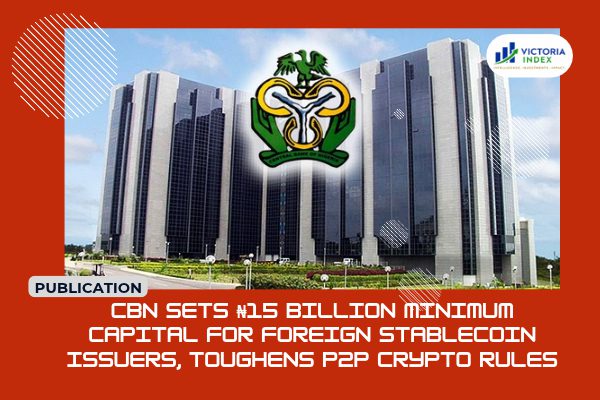
CBN requires foreign stablecoin issuers to hold ₦15 billion locally and now regulates P2P crypto trading. Here is what changes.
Nigerians trade more crypto, especially dollar-linked stablecoins, than almost anyone expects of a country with strict foreign exchange controls. On Thursday, 5 November 2026, the Central Bank of Nigeria moved to bring much of that activity under formal rules. Its new Regulations for the Operations of Non-Security Virtual Assets in Nigeria set a minimum paid-up capital of ₦15 billion for issuers of foreign-currency stablecoins and put peer-to-peer (P2P) crypto platforms under tighter supervision.
This report by Fafemi Godwin Uche explains what the rules say, why the CBN is acting now, and what the changes could mean for issuers, exchanges, traders and ordinary users. A note on sourcing: the figures below are reported consistently across several outlets, but VictoriaIndex had not been able to review the full regulation text at the time of writing. Readers should confirm details against the document on the CBN website.
The regulation sets out licensing, capital, governance and operational requirements for stablecoin issuers and other virtual asset service providers. It covers activities in or from Nigeria, activities directed at Nigerians, and operations capable of materially affecting the payments system, the financial system or the foreign exchange market. Virtual assets that count as securities or investment contracts stay with the Securities and Exchange Commission (SEC), which keeps oversight of that part of the market.
The new rules follow a clear policy path. On 17 July 2026, President Bola Tinubu signed the Executive Order on Virtual Assets Coordination, which made the CBN chair of a new Virtual Asset Council. The Order says securities-related activity remains with the SEC, while payment, settlement, custody and other non-security virtual asset services fall under the CBN. The government broadcaster summarises that framework on the Voice of Nigeria website. The CBN then opened a second cohort of its regulatory sandbox on 12 August 2026 with a track for virtual asset businesses, which you can see on the CBN sandbox portal. The SEC separately published proposed rules on digital and virtual asset operations, custody and markets on 20 August 2026, available on the SEC Nigeria website. The new regulation is the CBN’s piece of that larger puzzle.
The CBN splits stablecoins into classes and attaches a different capital floor to each.
| Category | What it covers | Minimum paid-up capital |
|---|---|---|
| Class 2 stablecoins | Foreign-currency-referenced (for example, dollar-linked) | ₦15 billion (about $11.16 million) |
| Class 1 stablecoins | Naira-referenced | ₦10 billion (about $7.44 million) |
| Other non-security virtual asset service providers | For example, certain platforms and custody providers | ₦1 billion |
The capital must be held on entry and throughout operations. Where a company already holds an SEC licence, the CBN capital requirement is reported to be in addition to what the SEC prescribes, so the same money cannot be counted twice.
The most important change is aimed at companies outside Nigeria. Class 2 stablecoins can only be issued through a Nigerian-incorporated entity that holds a valid CBN licence. That entity must keep a staffed physical office in Nigeria, have effective local management and be able to meet the regulator’s supervisory demands. The CBN also said there is no offshore exemption. A foreign approval, or operating from abroad, does not remove the need to incorporate, obtain a licence and meet the capital rule.
The regulation also sets out how stablecoins must be run. Reporting indicates issuers must hold full reserve backing plus an extra 2% overcollateralisation, and may not mint tokens against reserves they expect to receive in future. Algorithmic stablecoins, which hold their value through supply adjustments with little reserve backing, are banned. So are certain crypto-collateralised arrangements and tokens issued by sanctioned entities or jurisdictions. Issuers are also reported to be barred from paying interest or returns on stablecoin holdings. Class 2 issuers face separate operational liquidity requirements so they can meet redemption demand inside Nigeria, particularly when the foreign exchange market is under stress. Finally, issuers must tell holders clearly that CBN licensing is not a guarantee or endorsement of the token’s value, reserves or convertibility.
For most Nigerian users, the P2P rules matter more than the capital figures. Platforms that facilitate peer-to-peer crypto trades must now obtain specific CBN approval before offering the service. Before releasing or crediting regulated tokens, they must verify that the name on the naira payment and receiving accounts matches the user’s Bank Verification Number (BVN). In plain terms, a trade should be tied to a real bank account in the trader’s own name, and payments from or to third-party accounts should not be accepted.
The CBN also gave itself the power to restrict or suspend P2P operations where it considers it necessary to protect monetary stability, the foreign exchange market, consumers or the wider financial system. And the rules prohibit using offshore entities, unhosted wallets or P2P arrangements to get around foreign exchange and other regulations.
The central concern is the exchange rate. The naira has been weak against the dollar, and Nairametrics reported that it closed at ₦1,350.45 per dollar on the official market on 6 November, extending its November losses. When the official rate and the street rate diverge, dollar-linked stablecoins become a cheap, fast way to move value out of naira, and P2P platforms are the usual channel. By requiring BVN-matched accounts, local licences and local liquidity, the CBN is trying to make crypto flows visible and to ensure that, if a stablecoin issuer fails or comes under pressure, holders in Nigeria can still be repaid.
Anti-money-laundering and consumer protection are the other drivers. Matching payments to BVNs makes anonymous or third-party trading harder, and the reserve and disclosure rules are meant to reduce the risk of collapses of the kind seen in other markets.
The following is our analysis after reviewing the statement from the regulator.
Foreign issuers and exchanges. A ₦15 billion floor, at roughly $11 million, is not large for a global issuer, but the requirement to incorporate, staff an office, hold local liquidity and accept CBN supervision is a real shift in operating model. How this applies to tokens such as USDT and USDC, which Nigerians already use through global platforms, is not yet clear from the reports we reviewed. Expect clarification from the CBN, and watch whether issuers choose to apply, partner with a local licensee or stay out.
Local startups. The three capital tiers favour well-funded firms. A ₦10 billion floor for naira stablecoins and ₦1 billion for other providers is a heavy burden for small teams, which may lead to partnerships, mergers or exits. On the other hand, a licensed route could attract institutional money and banks that previously avoided the sector.
P2P traders. The BVN-matching rule means the days of paying through a third party’s account are numbered on regulated platforms. Traders who rely on multiple accounts or intermediaries will need to change how they operate. Platforms that cannot get approval may stop serving Nigerians.
Ordinary users. In the long run, users could gain from clearer protections, such as reserve backing and mandatory disclosures. In the short run, expect friction, delays and possibly reduced access while platforms apply for approval. People holding stablecoins on unlicensed platforms should check each provider’s status once the CBN publishes its list of licensed operators.
Banks and the wider market. Banks that decide to serve licensed virtual asset firms may find a new business line, but they will also take on compliance duties. Readers who prefer to invest through the regulated stock market can see how some Nigerian companies are performing in our coverage of the top Nigerian stocks to watch in 2026, though that article is not investment advice.
Several points remain open. The reports we reviewed did not say how long existing operators have to comply or when licensing applications open. It is also unclear which platforms the CBN will approve for P2P, whether existing global tokens must be re-issued locally, and how the CBN will treat users who already hold stablecoins on platforms that decide to leave. Pressure on the foreign exchange market matters here too. Dollar demand from large importers and energy firms already weighs on the naira, as we noted in our report on the Dangote Refinery’s nine-month results. Corporate earnings, such as MTN Nigeria’s strong nine-month profit, also show how digital and data services keep expanding, which feeds demand for new payment tools.
Three things deserve attention. First, the CBN’s licensing timetable and any list of approved P2P platforms. Second, whether major issuers or exchanges announce Nigerian entities or exit plans. Third, any changes to the official and parallel exchange rates, which show whether the rules reduce crypto-based dollar demand. SEC Nigeria’s final rules on digital assets will also shape how the two regulators’ lines are drawn in practice.
The CBN has taken a firm position: stablecoins and P2P crypto can operate in Nigeria, but only with local licences, local capital and verified identities. For large issuers and well-capitalised platforms that may be a manageable cost of entry, and for users it could mean clearer protection. For smaller operators and for traders who depend on informal methods, it is a significant tightening. How strictly and how quickly the rules are enforced will decide who wins and loses. VictoriaIndex will update this report once the CBN publishes its timetable and licensing details.
Sources: Central Bank of Nigeria; CBN Regulatory Sandbox; Securities and Exchange Commission, Nigeria; Voice of Nigeria.
More from the Markets category: