Physical Address
Victory Est, Ogombo Ajah, Eti-Osa, Lekki 101245, Lagos
Physical Address
Victory Est, Ogombo Ajah, Eti-Osa, Lekki 101245, Lagos

Nigeria Financial News, Stock Market Data, Economy & Market Analysis
Nigeria Financial News, Stock Market Data, Economy & Market Analysis
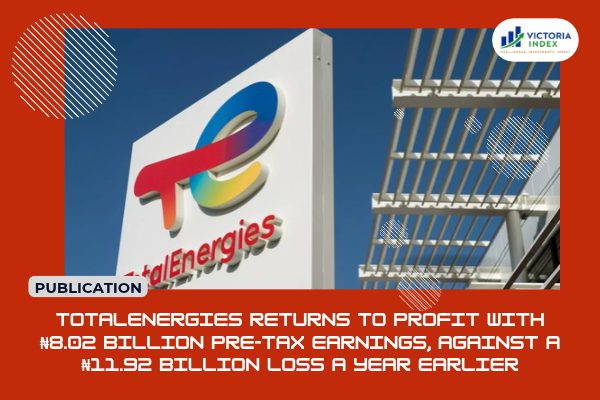
TotalEnergies Marketing Nigeria swung from a ₦11.92 billion loss to a ₦8.02 billion pre-tax profit as finance costs fell 40%.
TotalEnergies Marketing Nigeria Plc has returned to profit. For the nine months ended September 30, 2026, the fuel and lubricants marketer reported a pre-tax profit of ₦8.02 billion, compared with a loss of ₦11.92 billion in the same period of 2025. Profit after tax came in at ₦5.84 billion against a loss of ₦14.10 billion. The unaudited results were filed with the Nigerian Exchange (NGX) on October 23.
It is a clear reversal, but a thin one. The company earned less than one kobo of profit for every ₦100 of sales, and its finance bill was larger than its pre-tax profit. This report breaks down the numbers, shows where the improvement came from, and explains why the third quarter fell short of the company’s own forecast.
| Measure | 9M 2026 | 9M 2025 | Change |
|---|---|---|---|
| Revenue | ₦661.92bn | ₦587.59bn | +12.65% |
| Gross profit | ₦78.52bn | ₦65.76bn | +19.42% |
| Operating profit | ₦19.16bn | ₦5.65bn | +238.89% |
| Finance costs | ₦12.30bn | ₦20.55bn | -40.13% |
| Profit/(loss) before tax | ₦8.02bn | (₦11.92bn) | Swing to profit |
| Profit/(loss) after tax | ₦5.84bn | (₦14.10bn) | Swing to profit |
| Earnings/(loss) per share | ₦17.21 | (₦41.54) | Swing to profit |
The 2025 comparatives match the company’s own third-quarter 2025 filing on the NGX document library, which showed revenue of ₦587.59 billion and a pre-tax loss of ₦11.92 billion.
Three things moved in the right direction at once. Revenue grew, cost of sales rose more slowly, and the company paid much less to lenders.
Cost of sales rose 11.80% to ₦583.39 billion, below the 12.65% growth in revenue. That lifted the gross margin to 11.86% from 11.19%. Administrative expenses fell 1.09% to ₦59.56 billion, which helped operating profit more than triple to ₦19.16 billion. Selling and distribution costs rose to ₦7.66 billion from ₦6.69 billion, and net impairment losses on financial assets climbed to ₦346.89 million from ₦69.74 million, so not every cost line improved.
The company’s net profit margin remained below 1%. In a business that moves hundreds of billions of naira in fuel and lubricants, a few billion in profit still means very small margins, so one bad quarter can wipe out the gains.
White petroleum products, meaning petrol, diesel and aviation fuel, drove almost all of the growth.
| Revenue line | 9M 2026 | Change |
|---|---|---|
| White petroleum products | ₦472.66bn | +17.74% |
| Lubricants and other products | ₦189.26bn | +1.68% |
| Network (retail stations) | ₦370.67bn | +16.82% |
| General trade | ₦244.91bn | +19.09% |
White products brought in ₦472.66 billion against ₦401.46 billion a year earlier. They supplied roughly ₦71.2 billion of the ₦74.33 billion rise in total revenue, or about 96%. Lubricants grew much more slowly. By our arithmetic, the remaining aviation segment contributed about ₦46.3 billion, since network and general trade add up to ₦615.58 billion of the ₦661.92 billion total. That aviation figure is derived, not reported.
Finance costs fell 40.13% to ₦12.30 billion from ₦20.55 billion. Interest on bank overdrafts fell 43.26% to ₦11.58 billion and makes up most of the bill, while overdraft balances dropped 30.02% to ₦59.26 billion. Total loans and borrowings eased 3.44% to ₦81.76 billion.
A reduction in borrowing costs has been the story across Nigerian companies this year. Press coverage of the first-quarter results linked part of the improvement to a gentler interest-rate environment under the Central Bank of Nigeria, whose policy decisions are published on the CBN website. We saw the same pattern at Nestle Nigeria, where lower finance costs explained most of the profit jump, and at Guinness Nigeria, which also benefited from a collapse in interest expense.
For TotalEnergies the financing burden is still heavy. The ₦12.30 billion finance bill is about 64% of operating profit and larger than the ₦8.02 billion pre-tax profit. From the reported figures, we calculate that net finance costs were about ₦11.1 billion, which is the gap between operating profit and pre-tax profit. That is our estimate and not a reported number.
Nigerian listed companies publish quarterly profit forecasts on the NGX, which lets us compare plans with results. The company’s second-quarter forecast filing projected a pre-tax profit of about ₦2.00 billion for April to June.
| Quarter | Revenue | Operating profit | Pre-tax profit | Profit after tax |
|---|---|---|---|---|
| Q1 2026 | Not separately reported here | ₦6.1bn | ₦1.9bn | ₦1.17bn |
| H1 2026 | ₦443.99bn | Not reported here | ₦6.71bn (derived) | ₦4.95bn |
| Q3 2026 | ₦217.92bn | ₦4.64bn | ₦1.31bn | ₦0.89bn |
| Q3 2025 | ₦163.69bn | (₦4.66bn) | (₦10.23bn) | (₦11.25bn) |
Q1 figures are from the company’s first-quarter 2026 filing, as reviewed by VictoriaIndex. The Q3 2025 figures come from press coverage of that quarter. The half-year pre-tax figure is nine-month profit minus Q3, so it is derived.
Third-quarter pre-tax profit of ₦1.31 billion was about half the ₦2.62 billion forecast, even though revenue beat the forecast and rose 33.13% to ₦217.92 billion. By our estimate, April to June produced about ₦4.8 billion of pre-tax profit, which would mean the second quarter beat its ₦2.00 billion forecast by a wide margin while the third quarter fell behind. This estimate is derived from the reported figures. The lesson is that quarterly results at this company can swing widely, so one good or bad quarter says little about the trend.
Cash flow improved. Operating cash flow rose 66.72% to ₦38.27 billion, though part of that came from higher payables and lower tax payments, so it may not repeat. Total assets grew to ₦426.31 billion from ₦388.55 billion at the end of 2025.
| Balance sheet item | 30 Sept 2026 | Change |
|---|---|---|
| Current assets | ₦349.04bn | +12.36% |
| Current liabilities | ₦360.10bn | +8.86% |
| Net working capital | (₦11.06bn) | From (₦20.15bn) at December 2025 |
| Trade and other receivables | ₦165.23bn | +27.52% |
| Trade and other payables | ₦270.40bn | +14.32% |
| Bank overdrafts | ₦59.26bn | -30.02% |
The working-capital deficit narrowed but current liabilities still exceed current assets. Receivables grew faster than sales, so more cash is tied up in money owed by customers. The company also disclosed a new ₦22.50 billion short-term intercompany loan denominated in dollars with a variable interest rate. That creates exposure to exchange rates and borrowing costs that the company did not carry before. It employed 403 people in September 2026, down from 411 a year earlier.
The recovery makes more sense against last year’s slump. For the full year 2025, TotalEnergies posted a pre-tax loss of about ₦12.5 billion, its first loss in six years, after revenue dropped 26% and finance costs rose 12% to ₦21.99 billion, according to VictoriaIndex review on the audited figures. The after-tax loss was about ₦17.18 billion, against a ₦27.40 billion profit in 2024. Revenue fell from ₦793.9 billion in the first nine months of 2024 to ₦587.6 billion in the first nine months of 2025, which is the contraction that sank earnings.
TotalEnergies SE, the parent group, reported net income of $19.5 billion for the first nine months of 2026, driven by what its chief executive called historic refining margins. The Nigerian business is different. It buys and sells fuel and lubricants and earns a thin margin on volume, so it does not enjoy the windfall that refiners get when the gap between crude and fuel prices widens. The group’s results are on the TotalEnergies website, and the local company’s own information is at TotalEnergies Nigeria.
The local supply chain is also changing. Regulator data from the Nigerian Midstream and Downstream Petroleum Regulatory Authority (NMDPRA) showed the Dangote refinery supplying 87.55% of petrol delivered to the domestic market in May. Our reports on the Dangote Refinery’s nine-month profit and its IPO explain how local refining is reshaping the sector, and our piece on how oil prices drive Nigerian energy stocks shows why fuel prices matter to listed companies. For the wider picture of profits this season, see our reports on MTN Nigeria and International Breweries, and our look at the 2026 NGX rally.
Several things will decide whether this recovery lasts. The first is finance costs, which still absorb most operating profit. The second is the dollar loan, which adds currency risk. The third is the receivables balance, since slow collection can squeeze cash even when profits look fine. The fourth is margin, because a gross margin near 12% leaves little room for error. Inflation figures from the National Bureau of Statistics and rate decisions from the CBN affect the company’s costs and customers, and all filings appear on the Nigerian Exchange.
TotalEnergies Marketing Nigeria is back in the black, and the improvement is genuine. Higher fuel sales, a better gross margin and a sharp fall in finance costs all contributed. But the profit is small, the third quarter missed its target, working capital is still negative and a new dollar loan has been added. Investors should treat this as the start of a repair and not a finished turnaround. The figures are unaudited, and we will update this report if the company revises them.
Sources: TotalEnergies Marketing Nigeria’s filings on the NGX document library: Q3 2025, Q1 2026 and the Q2 2026 forecast; the NMDPRA; the CBN; TotalEnergies SE; nine-month figures as reviewed by VictoriaIndex, Tribune and Nigeria Housing Market.
Editorial note: This article is for information only and is not investment advice. Please read our Financial Disclaimer and Editorial Policy.