Physical Address
Victory Est, Ogombo Ajah, Eti-Osa, Lekki 101245, Lagos
Physical Address
Victory Est, Ogombo Ajah, Eti-Osa, Lekki 101245, Lagos

Nigeria Financial News, Stock Market Data, Economy & Market Analysis
Nigeria Financial News, Stock Market Data, Economy & Market Analysis
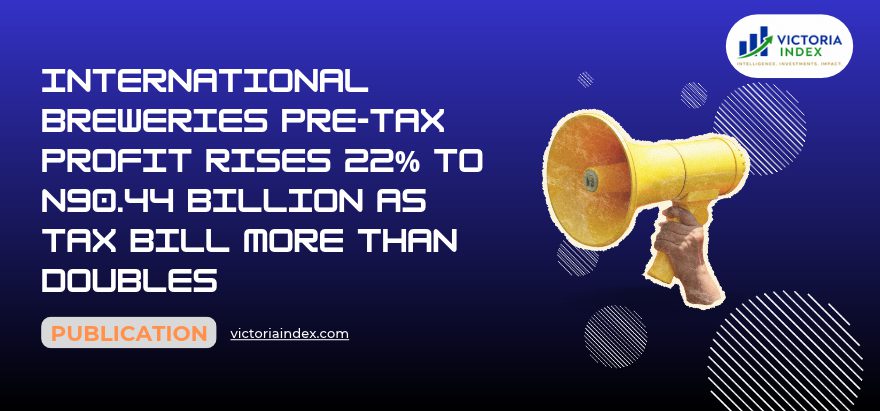
International Breweries pre-tax profit rose 22% to N90.44 billion in nine months, but a higher tax bill cut after-tax earnings.
International Breweries pre-tax profit climbed to N90.44 billion in the nine months ended 30 September 2026, an increase of about 21.9% from N74.2 billion a year earlier. The improvement did not reach shareholders in full. A sharp rise in income tax pushed profit after tax down 5.74% to N54.51 billion, and earnings per share slipped to 32 kobo from 34 kobo.
The unaudited results were filed with the Nigerian Exchange (NGX) on Monday, 26 October 2026. VictoriaIndex reviewed the company’s filing and the figures reported around it. This report sets out what drove the stronger operating performance, why the tax line changed the outcome, what the balance sheet says about the N84 billion capital return, and what investors in the INTBREW stock should watch before the year closes.
Revenue for the nine months came in at N482.61 billion, up just 2.12% from N472.57 billion in the same period of 2025. That is modest growth for a business operating in a high-inflation economy, and it means the profit improvement did not come from selling much more or charging much higher prices.
The real change happened in the cost of making and delivering beer. Cost of sales fell 8.02% to N286.67 billion, which lifted gross profit by 21.76% to N195.94 billion. Gross margin widened to 40.61% from 34.05%. Materials consumed and allocated overheads dropped 14.35% to N222.83 billion, which accounts for most of the saving. Realised foreign exchange losses also narrowed by roughly 36% to N8.63 billion, a relief for a company that buys imported inputs.
Operating profit rose 20.66% to N80.86 billion. That is a healthy result, but the filing also shows pressure building in selling costs. Administrative, marketing and distribution expenses grew 26.13% to N116.16 billion, and advertising, promotion and distribution costs rose 36.68%. In effect, cost savings in the brewery outweighed higher spending to push products into the market. Whether that balance holds will depend on how long input costs stay low.
The full filing is available on the Nigerian Exchange document library, and VictoriaIndex encourages readers to consult it directly.
Below the operating line, net finance income increased about 33% to N9.58 billion. Finance income of N19.63 billion comfortably exceeded finance costs of N10.05 billion. This is an unusual position for a Nigerian manufacturer, since most listed companies in the sector have spent recent years absorbing heavy interest bills.
International Breweries reported no outstanding bank loans or overdrafts as of 30 September 2026. Its income from deposits and short-term investments is therefore doing real work. That helps explain why pre-tax profit grew at about the same pace as operating profit.
For readers trying to understand how interest rates shape corporate results, VictoriaIndex has covered the other side of the story in its explainer on how the rising cost of credit is changing borrowing in Nigeria. A company with cash and no debt benefits from high rates, while a heavily indebted one is hurt by them.
Income tax expense surged 119.25% to N35.93 billion from N16.39 billion. A simple VictoriaIndex calculation puts the effective tax rate at close to 39.7% of pre-tax profit this year, against about 22.1% in the first nine months of 2025. The increase of N19.54 billion in tax is larger than the entire N16.23 billion improvement in pre-tax profit, which is why profit after tax went backwards.
The pattern is not new. In the first half of 2026, pre-tax profit rose 21.55% to N74.79 billion while profit after tax fell 7.21%. The nine-month result shows the same gap widening, with a slightly deeper decline in after-tax earnings.
The coverage reviewed by VictoriaIndex does not give a full explanation for the higher charge, and the company will need to clarify it for investors. Readers who want to understand how corporate tax obligations are set and collected in Nigeria can consult the Federal Inland Revenue Service, the agency responsible for federal tax administration. Until the drivers of the tax line are clearer, analysts will find it difficult to forecast how much of the operating gain can reach the bottom line in the fourth quarter.
Looking at the third quarter alone, the picture was firmer. Based on the difference between half-year and nine-month figures, pre-tax profit for the quarter was approximately N15.65 billion, up from N12.71 billion in the third quarter of 2025. Quarterly revenue rose about 6.8% to N140.54 billion, and quarterly gross profit increased roughly 38.9% to N54.65 billion.
Those numbers suggest the margin recovery is continuing rather than fading. Revenue growth in the single digits, however, remains the weak spot. A brewer that cuts costs can only do so for a limited time, and sustained profit growth eventually requires higher volumes or better pricing.
Cash flow is where this result looks most convincing. Cash generated from operations rose to N121.10 billion from N38.42 billion a year earlier, and net operating cash flow reached N114.43 billion. Capital expenditure was N85.13 billion, broadly in line with the previous year, so the business funded its investment from internal resources.
For investors, cash flow is often a more reliable signal than reported profit, because accounting charges such as tax provisions and non-cash items can move the headline figure around. A company that generates this much cash and carries no bank debt has considerable flexibility.
Cash and cash equivalents fell 33.27% to N103.74 billion from N155.45 billion at the end of December 2025. The main reason was a N84 billion return of capital to shareholders. Net financing outflows totalled N99.71 billion, and the capital return accounted for most of that amount. The qualification date was 16 September 2026, with payment scheduled for 23 September.
The payout also reduced total shareholders’ equity by 5.90% to N470.33 billion. Importantly, a return of capital is different from an ordinary dividend. It is a distribution out of share capital rather than out of current profit, which matters for how investors compare income across companies. VictoriaIndex’s guide to the best dividend stocks on the NGX explains how to tell these payouts apart and why consistency of ordinary dividends is the better test of income quality.
International Breweries ended 2025 with accumulated losses of N191.03 billion, a legacy of the heavy losses it recorded in earlier years. Until those losses are cleared or restructured, the company has limited room to pay ordinary dividends from profit, even though current earnings are strong. The company has proposed a share capital reduction to restore distributable reserves, and progress on that proposal will be one of the key developments for shareholders to follow.
Ownership disclosures in the filing show AB InBev Nigeria Holdings BV with a reported stake of 96.01%, up from 78.44%. Brauhaase International Management GmbH’s stake declined to 1.41% from 8.85%. With reported share counts unchanged and combined substantial holdings steady at 97.42%, the shift appears to reflect a reclassification of holdings rather than fresh share purchases.
The practical meaning is that only a very small portion of the company is available to ordinary investors. This affects liquidity and price behaviour, and it is the reason investors should understand market capitalization and free float on the NGX before buying a stock with such concentrated ownership.
The market has not rewarded the improvement so far. International Breweries shares closed at N8.80 on 26 October, down about 2.76% from N9.05 the previous Friday, after the results were released. The stock has lost roughly 37% of its value since the start of the year, when it traded at N14, and it has fallen about 9% since 24 September.
That reaction shows investors are looking past the 22% headline growth to the after-tax decline, the weak revenue growth and the absence of an ordinary dividend. It also stands out against a year in which Nigerian equities have generally performed well, a theme VictoriaIndex examined in its analysis of the 2026 NGX rally. Investors who want to act on any listed stock need a working account with the Central Securities Clearing System, and VictoriaIndex’s beginner’s guide to CSCS Nigeria explains the process.
Four things will shape the next set of results. The first is the fourth-quarter tax charge, which will show whether the higher rate is a lasting feature or a one-off. The second is revenue growth, since margin gains alone cannot carry profit indefinitely. The third is selling expense, which is rising faster than sales. The fourth is the share capital reduction, which determines when ordinary dividends can resume.
Investors seeking official information should rely on primary sources. The Nigerian Exchange Group publishes company filings and corporate action notices, and the Securities and Exchange Commission, Nigeria regulates the capital market and issues investor guidance.
International Breweries pre-tax profit rose 22% to N90.44 billion on cost savings, narrower currency losses and stronger finance income, backed by very strong operating cash flow and no bank debt. The offsetting factor is a tax charge that more than doubled and cut after-tax profit by 5.74%. With weak revenue growth, accumulated losses and a falling share price, the case for the stock depends on whether operating gains can survive the tax line. VictoriaIndex will continue to track the company’s filings and report on developments as they emerge.
Financial disclaimer: This article is for information only and does not constitute investment advice. Figures are drawn from unaudited company filings and may change. Readers should do their own research or consult a licensed adviser before investing.