Physical Address
Victory Est, Ogombo Ajah, Eti-Osa, Lekki 101245, Lagos
Physical Address
Victory Est, Ogombo Ajah, Eti-Osa, Lekki 101245, Lagos
Nigeria Financial News, Stock Market Data, Economy & Market Analysis
Nigeria Financial News, Stock Market Data, Economy & Market Analysis
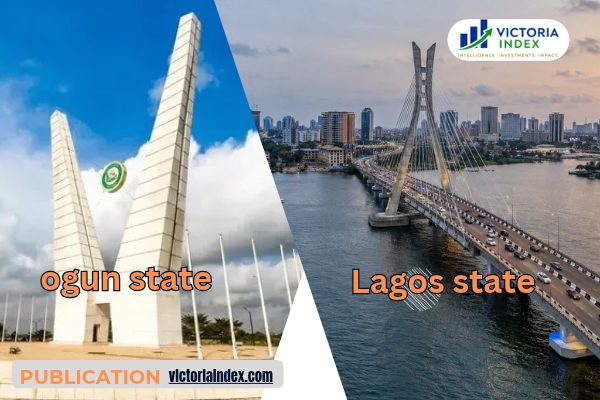
Lagos still anchors Nigerian commerce, yet costs push firms toward Ogun. We compare land, power, taxes and logistics in both.
In the United States, people often describe a quiet migration from expensive New York to cheaper Florida. Nigeria has its own version of that story, and it runs about an hour up the Lagos-Ibadan Expressway. Lagos remains the country’s commercial centre, with the biggest market, the busiest ports and the deepest pool of talent. Ogun State, which borders it, has spent years pitching itself as the cheaper, roomier alternative for factories and warehouses.
The comparison has a catch that the Florida image hides. Ogun is not a different country. Many companies move their plants to Ogun and keep their offices, customers and bank relationships in Lagos. So the real question for a business owner is less “should I leave Lagos?” and more “which costs should I move out of Lagos, and which new costs will follow me?” This report examines that question using published data from manufacturers’ groups, state governments and property listings. Where we rely on asking prices or reported claims, we say so.
It helps to know the shift has a long history. Data from the Manufacturers Association of Nigeria (MAN), analysed by VictoriaIndex, showed Ogun taking about 74% of manufacturing investment in 2014, with N514.87 billion of N691.77 billion going to the state. Investors then cited land rebates, better roads and security for plants, and complaints about touts collecting unofficial levies in Lagos. That data is old and should not be read as today’s split, but it shows Ogun’s pull is more than a few years old.
More recently, VictoriaIndex discovered that Ogun has more than 6,000 registered industrial firms, an operating Gateway International Airport and the planned Dangote Olokola Deep Seaport. A Guardian analysis, citing the state’s investment agency, put foreign investment commitments above $1.8 billion between 2023 and mid-2025, with over 60% in manufacturing. Those are state-sourced figures and should be read as such.
The table below summarises the main differences. It draws on published sources and listings, and it is not a substitute for a site-specific quote.
| Cost factor | Lagos | Ogun |
|---|---|---|
| Industrial land (illustrative asking lease) | A 2,600 sqm fenced industrial plot in Oregun, Ikeja listed at ₦70 million a year (about ₦27,000 per sqm) | A one-acre fenced plot on the expressway at Ibafo listed at ₦15 million a year (about ₦3,700 per sqm) |
| Port access | Closest to Apapa, Tin Can and Lekki, but the Apapa corridor has long had traffic problems | Roughly 30 to 60 km from the main ports, according to one analysis, with expressway congestion as a risk |
| Electricity | Manufacturers nationally rank erratic power among their top problems | MAN’s Ogun branch says most members rely on self-generated power |
| Taxes and levies | MAN says 84% of manufacturers pay more than five state and local levies, spending about 18 man-days a month on compliance | MAN Ogun reports multiple taxation and overlapping regulators; the governor has promised harmonisation |
| Roads and logistics | Dense traffic, strong market proximity | Poor industrial roads and high logistics costs reported in Agbara, Ota and Sagamu |
| Market and talent | Largest consumer market and talent pool in the country | Near Lagos, but smaller local market |
| Reform status | Lagos Industrial Policy 2025 to 2030; Assembly moving to harmonise taxes | Government committee to review duplicate charges |
Property is where the gap is widest. The two listings in our table are single examples from the Nigeria Property Centre, not averages, and asking prices are always negotiable. Even so, the difference per square metre is roughly sevenfold. Other Ogun listings tell a more complicated story. Expressway-frontage land for sale along the Lagos-Ibadan corridor is advertised at anywhere from tens of millions to several hundred million naira per acre, which means the “Ogun is cheap” idea holds best for leased land away from the most prized frontage and for buyers who are willing to go a little further inland. Anyone planning a move should treat listing prices as a starting point and demand to see title documents, such as a Certificate of Occupancy and the Governor’s consent, before paying anything.
Cheap land is only one line in a company’s budget, and this is where the Florida comparison starts to wobble.
Power. At the 41st annual general meeting of MAN’s Ogun branch in Abeokuta, outgoing chairman George Onafowokan said most manufacturers rely on self-generated electricity because public supply is unreliable, which sharply raises operating costs. This contradicts some commentary describing steady power in the state, and for factory owners the testimony of the manufacturers’ own branch is the more relevant evidence. MAN’s national confidence index for the second quarter of 2026 listed access to finance as the biggest challenge, followed by erratic power and limited foreign exchange access. Those pressures are not unique to either state.
Taxes. Ogun’s tax advantage is less certain than its land advantage. MAN’s Ogun branch told the state government that multiple taxes, environmental levies and overlapping agency responsibilities create an unpredictable climate. Ogun’s Governor, Dapo Abiodun, said the state would harmonise taxes and levies before the end of his administration, and a government official said a committee would review duplicative charges. Meanwhile, Lagos faces the same complaint. MAN’s Apapa branch has urged a single tax framework, and its president said manufacturers spend about 18 man-days a month meeting tax obligations. Nationally, MAN said in August 2026 that manufacturers still faced multiple tax collectors and regulators despite the Nigeria Tax Act 2025, which was meant to stop that. In short, neither state has solved the problem.
Roads and logistics. Ogun’s industrial clusters are close to Lagos, but that closeness depends on the quality of the roads in between. MAN Ogun and a state official both acknowledged poor industrial roads and high logistics costs in Agbara, Ota and Sagamu. The Lagos-Ibadan Expressway is still being reconstructed, so the full benefit of the corridor has not yet arrived.
It would be a mistake to read this as a story of decline. MAN’s president has said Lagos contributes over 60% of Nigeria’s manufacturing output. For businesses that depend on foot traffic, fast delivery to consumers, banks, regulators, ports or skilled staff, being in Lagos still pays. The state is also responding. It has published an Industrial Policy for 2025 to 2030, and its government says it is working on traffic reforms and road rehabilitation in the Apapa corridor.
Capacity utilisation in manufacturing nationally fell to 54.1% in the second half of 2025, according to MAN. That figure is a reminder that cheap premises do not rescue a factory that cannot sell what it makes.
Our economic correspondent, Kolawole Seyi, spoke with 2 business owners who moved and relocated their medium sized manufacturing plants from Lagos to Ogun State. We asked them questions like:
One respondent, Mrs. Olukutan, who runs a pure water company said the cost of rent, drove her out of Lagos.
Another business operator, who asked not to be named because most of his customers are in Lagos described the tax in Lagos as being crazy. He cited that while in Lagos, his business had to face problems of multiple taxation. “Tax officials come from the state and then after his company is visited by Local Government tax officials within the same month. And these happens month after month.”
We asked the third respondent, Engineer Francis Emeka Uzo, if logistics fee was not in his consideration during his decision to relocate his plastic chair manufacturing business to Ogun State. He confirmed logistics fee problem was what he was willing to tolerate compared to the problem of Lagos’s multiple taxation as well as the high cost of power.
A sensible decision weighs more than rent. First, ask where your customers and suppliers are, because a cheaper site that adds two hours to every delivery can wipe out the saving. Second, price power honestly, including diesel or gas for self-generation. Third, ask each state’s revenue authority and your local government for a written list of every levy you will face, and compare it with your current bill. Fourth, check title and consent documents with a lawyer before signing. Finally, consider a split model, with a production site in Ogun and sales, finance and headquarters in Lagos, which is what many firms appear to do.
Three developments will shape the comparison. The first is whether Ogun delivers its promised tax harmonisation, and whether Lagos completes its own. The second is progress on the Lagos-Ibadan Expressway and the Dangote Olokola seaport, which will change logistics costs. The third is whether electricity supply to industrial clusters improves in either state.
On the evidence available, Ogun offers a real advantage on land and space, and its role as Lagos’s industrial overflow is well established. But power, taxes and road costs travel with a business wherever it goes, and Lagos still holds the market, the ports and the talent. The “Florida” label fits only partly. For most firms, the smartest answer is not leaving Lagos but deciding precisely which parts of the business belong in each place. VictoriaIndex will keep tracking the data and will publish updates as new figures come in.
Sources: MAN reports and statements as covered by The Guardian, Vanguard and BusinessDay; property listings on Nigeria Property Centre; Lagos State Government; Ogun State Government.
Related reading: