Physical Address
Victory Est, Ogombo Ajah, Eti-Osa, Lekki 101245, Lagos
Physical Address
Victory Est, Ogombo Ajah, Eti-Osa, Lekki 101245, Lagos
Nigeria Financial News, Stock Market Data, Economy & Market Analysis
Nigeria Financial News, Stock Market Data, Economy & Market Analysis
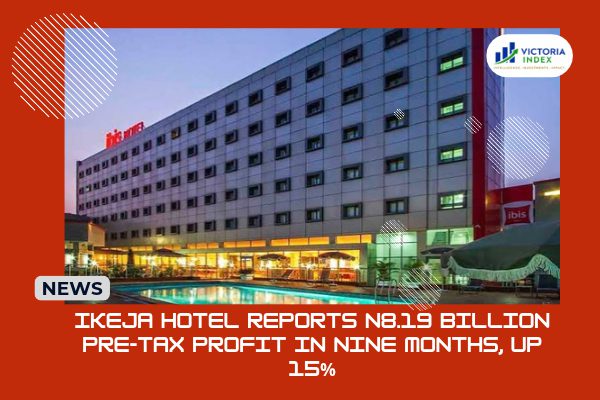
Ikeja Hotel's nine-month pre-tax profit rose 15% to N8.19 billion, but operating profit fell as finance income carried the earnings.
On paper, Ikeja Hotel Plc had a good nine months. Profit before tax reached N8.19 billion for the period ended September 30, 2026, up 15.10% from N7.12 billion a year earlier. Profit after tax climbed 14.22% to N5.31 billion. If you only read the headline, you would assume the hotel business is firing on all cylinders.
The detail is more interesting, and a little less comfortable. The company that owns the Sheraton Lagos Hotel saw its operating profit fall, its third quarter weaken, and its pre-tax growth lean heavily on money earned outside the rooms and restaurants. In this article we separate the real hospitality story from the accounting story, so that readers of the NGX filing can judge for themselves.
| Metric | 9M 2026 | 9M 2025 | Change |
|---|---|---|---|
| Revenue | N19.41 billion | N18.52 billion | +4.84% |
| Operating profit | N6.22 billion | N6.90 billion | down 9.76% |
| Profit before tax | N8.19 billion | N7.12 billion | +15.10% |
| Tax expense | N2.89 billion | N2.47 billion | up about 17% |
| Profit after tax | N5.31 billion | N4.65 billion | +14.22% |
| Q3 profit before tax | N2.08 billion | N2.44 billion | down 14.52% |
Source: VictoriaIndex, based on the company’s filing. Percentage change in tax expense is our own calculation.
Two lines in this table pull in opposite directions. Pre-tax profit rose 15%, but operating profit fell almost 10%. That gap is the heart of the story.
Revenue rose a modest 4.84% to N19.41 billion. For a hotel group, that is slow growth, particularly compared with the previous year, when revenue in the same nine months surged by about 47% as occupancy recovered and room rates adjusted. A base that high makes new growth harder, so some cooling was expected.
The bigger concern is cost. Operating profit fell from N6.90 billion to N6.22 billion even though sales rose. That means expenses such as energy, food supplies, maintenance and staff costs grew faster than income. By our calculation, operating profit was about 32% of revenue this year against about 37% last year. In everyday terms, the hotel kept roughly 32 kobo of every naira of sales as operating profit, down from about 37 kobo.
NGN Market’s analysis points to the same pattern across listed hotels in 2026: guests and event bookings are holding up, but inflation in operating costs is moving faster. You can follow the national price trend on the National Bureau of Statistics website, and our own piece on why food prices remain high in Nigeria explains one of the main cost pressures hotels face.
If operating profit fell, something else had to lift pre-tax profit. That something was income earned away from the hotel’s core operations. Reports on the results say finance income rose by about 27% to N1.97 billion, partly because of the group’s financial investments and the way it manages its cash. Prior-year investment losses also did not repeat.
Here is the arithmetic. Subtract operating profit from pre-tax profit and you get what we can call the net contribution from non-operating items. This year that figure is about N1.97 billion. Last year it was only about N0.22 billion. In other words, the gap between operating profit and pre-tax profit widened by roughly N1.75 billion, and that more than covered the N0.68 billion decline in operating profit. These are our own calculations from the reported figures, so treat them as approximations, but the direction is clear.
This is not a new pattern. Nairametrics noted earlier in 2026 that financial assets made up about 71% of Ikeja Hotel’s assets, and that finance income helped boost the previous year’s pre-tax profit as well. The company also reported zero finance costs in 2025, compared with N1.33 billion in 2024, which made a big difference then. So Ikeja Hotel is part hotel operator and part investor, and investors should understand which part is driving growth.
Look at how the growth rate has changed through the year. In the first half of 2026, pre-tax profit rose 31.03% to N6.12 billion. After nine months, the growth rate had dropped to 15.10%. That is only possible if the third quarter was weak, and it was. Third-quarter pre-tax profit fell 14.52% to N2.08 billion, compared with an average of roughly N3.06 billion per quarter in the first half (our calculation).
A single quarter does not make a trend, and hotels have seasonal swings. The third quarter in Lagos can be quieter for corporate travel and events. Still, a fall in Q3 after a strong first half is worth watching when the fourth-quarter figures arrive. The final quarter usually brings year-end events, conferences and holiday travel, which can help.
Tax expense rose to N2.89 billion from N2.47 billion. That works out to an effective tax rate of about 35% of pre-tax profit, against about 35% a year earlier (our calculation), so there was no dramatic change in the tax burden here, unlike some other companies this season. Our analysis of Zenith Bank’s H1 results shows a very different story, where an unusually high tax charge cut sharply into profit after tax.
Because tax rose roughly in line with pre-tax profit, profit after tax grew at nearly the same rate, 14.22% against 15.10%. After-tax profit also gave a net margin of about 27%, up from about 25% last year (our calculation).
Ikeja Hotel is a small-cap by market value. Nairametrics reported its market capitalisation at about N101 billion in late July 2026, which placed it around 61st on the NGX. Its larger listed peer, Transcorp Hotels, operates at a bigger scale, and Ikeja ahead on margin and Transcorp ahead on absolute profit. For context on the parent company, see our report on Transcorp Group’s pre-tax profit falling to N111.4 billion, where revenue dropped but margins and cash improved.
For a consumer-facing comparison from outside hospitality, our coverage of Guinness Nigeria’s profit climbing 55% with another N7 interim dividend shows how a different sector is handling the same cost environment.
Ikeja Hotel declared an interim dividend of N0.03 per share in July 2026. That is 3 kobo per share, against full-year 2025 earnings per share of 384 kobo. The payout is token. Anyone buying the shares for income would be disappointed, and the case for owning them rests on earnings growth and asset value instead. If you are new to this topic, our guide on how NGX dividends work explains yield and payout ratio in plain terms.
You can check any company’s filings directly on the NGX website, and for the wider interest rate and inflation backdrop, see the Central Bank of Nigeria. If you are comparing asset classes, our guide on Bitcoin versus Nigerian stocks may help.
Ikeja Hotel’s 15% pre-tax growth is real money, but it is not the same as a booming hotel business. Revenue grew slowly, operating profit fell, the third quarter weakened, and the improvement came largely from finance income and the absence of earlier investment losses. That is not a criticism, since profit is profit, but it changes how much weight you should give the headline when judging the company’s future.
Disclaimer: This article is for information only and is not investment advice. Figures come from company filings. Please read the full results and consult your stockbroker before investing.