Physical Address
Victory Est, Ogombo Ajah, Eti-Osa, Lekki 101245, Lagos
Physical Address
Victory Est, Ogombo Ajah, Eti-Osa, Lekki 101245, Lagos
Nigeria Financial News, Stock Market Data, Economy & Market Analysis
Nigeria Financial News, Stock Market Data, Economy & Market Analysis
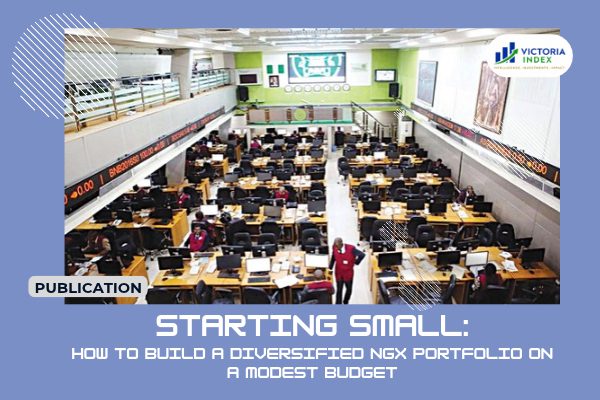
How to build a diversified NGX portfolio on a small budget, from choosing a broker to managing fees and risk.
Many Nigerians assume the stock market is for people with millions of naira. It is not. You can open an account and buy your first shares on the Nigerian Exchange (NGX) with an amount many people spend on a weekend. The harder problem for a small investor is not getting in. It is building a portfolio that does not rest on one company, one sector or one lucky tip, while keeping fees from eating the returns.
This VictoriaIndex guide explains how to build a diversified portfolio on a modest budget. It covers what to do before investing, how trading costs work, how to spread money across sectors, a sample allocation in naira, the main risks, and the habits that keep a small portfolio growing.
Shares can fall as well as rise, so the first step is making sure the money you invest is money you can leave alone. Keep an emergency fund in a safe, accessible place before buying equities. VictoriaIndex’s guide on how to hedge against inflation in Nigeria explains where idle cash can sit while it earns something, and the explainer on understanding risk before you invest your money helps you decide how much risk suits your situation.
Avoid borrowing to invest. A loan has to be repaid whether your shares rise or not, and loan interest in Nigeria is high. Only invest money you will not need for at least a few years, because short-term price swings can be sharp.
To buy shares on the NGX, you need a licensed stockbroker, a Central Securities Clearing System (CSCS) account where your holdings are recorded, and a bank account. Check that any broker you consider is registered with the Securities and Exchange Commission, Nigeria and is a member of the Nigerian Exchange Group. VictoriaIndex’s walkthrough on how to open a stockbroking account in Nigeria covers the documents and steps, and the guide to how CSCS works explains why your CSCS record is what proves you own the shares. The CSCS website carries further information.
Costs matter far more when the budget is small, because fees are charged as a percentage of each trade and some are fixed amounts. The NGX publishes its schedule of fees, which shows the main charges:
| Charge | Buy side | Sell side |
|---|---|---|
| Brokerage commission | 0.75% to 1.35% | 0.75% to 1.35% |
| SEC fee | 0.3% | None |
| NGX fee | None | 0.3% |
| CSCS fee | None | 0.3% |
| Stamp duty | 0.08% | 0.08% |
| Trade alert fee | N4 | N4 |
Value Added Tax (VAT) is also charged on some of these fees, and exact amounts vary by broker, so confirm the full breakdown before placing an order.
Here is what that means in practice. Suppose you buy N50,000 of a share through a broker charging the top-end 1.35% commission. The brokerage is N675, the SEC fee is N150, stamp duty is N40, the alert fee is N4, and VAT adds about N62, so the cost is roughly N931, or about 1.9% of the trade. Selling the same position later would cost roughly N1,090. By VictoriaIndex’s calculation, a round trip at the top end of the range costs around 4% of the amount invested, which means the share must rise about 4% just for you to break even. At the lower end of the commission range, the round trip is cheaper but still significant. These figures are illustrative and not a quote.
The lesson is simple. Fees punish frequent trading. A small investor who buys and sells every week gives away a large part of any gain. Buy with the intention of holding, and use fewer, better-planned purchases.
Diversification is not about owning the largest number of stocks. It is about owning assets that do not all fall for the same reason. Five bank shares are not diversified, because a banking regulation change or an interest rate shift can hit all of them at once.
On the NGX, a practical way to diversify is to spread money across sectors that respond to different forces. Banking responds to interest rates and regulation. Consumer goods respond to household spending and input costs. Industrials, including cement and building materials, respond to construction demand. Telecommunications respond to data usage and pricing. Oil and gas respond to energy prices and production. Holding some of each reduces the chance that one bad development damages the whole portfolio.
Company size and trading activity also matter. Larger, frequently traded companies are easier to buy and sell at fair prices. VictoriaIndex’s explainer on market capitalization and free float for NGX investors shows how to check whether a share is liquid enough for your needs. A stock with a tiny free float can be hard to sell when you want to.
The example below is hypothetical. It is not a recommendation to buy any sector or company, and it will not suit everyone. It shows how a small budget can be divided.
| Sector or bucket | Share | Amount |
|---|---|---|
| Banking | 25% | N50,000 |
| Consumer goods | 20% | N40,000 |
| Industrials and building materials | 20% | N40,000 |
| Telecommunications | 15% | N30,000 |
| Oil and gas | 10% | N20,000 |
| Cash reserve for later purchases | 10% | N20,000 |
Each sector slice could be one company. With a budget this size, a single well-chosen company per sector is more practical than splitting N30,000 across several, which would multiply the fees. The cash reserve lets you add to positions when you have researched a good opportunity, or when prices fall to levels you consider attractive.
If you cannot afford one share in each sector, build it in stages. Start with two or three sectors, then add the others as your savings grow. A portfolio is something you build over years.
Picking individual shares is not the only way to diversify. The NGX lists exchange-traded funds, which hold a basket of securities and trade like a single share, and many asset managers offer equity mutual funds that pool investors’ money. Either option can spread risk across many companies with a single purchase. They carry their own fees and risks, so read the fund documents and confirm the manager is registered with the SEC. VictoriaIndex’s list of financial terms every Nigerian should understand explains terms such as net asset value, expense ratio and unit price.
Research does not need to be complicated, but it should happen before you buy. Look at whether the company is profitable and whether profits are rising or falling, how much debt it carries, whether it pays dividends and whether it has done so consistently, and what its share price has done relative to its earnings. VictoriaIndex’s guide on how to analyze an NGX corporate earnings report walks through the key lines, and the explainer on how NGX dividends work shows how qualification dates and payments work, so you do not miss a payout you are entitled to.
Be cautious about tips from social media, messaging groups and strangers. Prices of thinly traded shares can be pushed around, and a “guaranteed” return is a warning sign in any investment.
Many small investors do well with a simple routine. Pick an amount you can afford, invest it monthly or quarterly, and spread purchases across your chosen sectors over time. Investing in regular instalments reduces the risk of putting everything in at a bad moment. Because each trade has costs, monthly or quarterly purchases are usually better than weekly ones.
Review your portfolio a few times a year, not every day. Check whether the original reasons for owning each share still hold, and whether any one position has grown so large that it dominates the portfolio. If it has, consider directing new money to smaller positions instead of selling, which avoids extra fees.
Keep records of every purchase, including the price, the date and the fees. They will help when you review performance and when you need information for tax filing. Rules on how investment income and gains are taxed have changed in recent years, so confirm the current position with the tax authority or a licensed adviser.
The usual errors are putting all your money in one sector or one stock, trading too often, chasing prices that have already jumped, ignoring fees, buying thinly traded shares you cannot easily sell, investing money you need soon, and panicking when prices fall. Inflation can also catch investors out. The National Bureau of Statistics publishes official inflation data that you can use to judge whether your investments are growing faster than prices.
You do not need a large sum to start investing on the NGX. You need a licensed broker, a CSCS account, an emergency fund, and a plan that spreads your money across sectors while respecting trading costs. Start small, buy with the intention of holding, keep fees low, research before you buy and review your portfolio calmly. The goal is steady growth over years, and a diversified portfolio built patiently gives you the best chance of reaching it.
Disclaimer: This article is for educational purposes only and does not constitute investment, tax or legal advice. The sample allocation and fee examples are hypothetical. Investing in shares involves the risk of loss, and fees and rules can change. Confirm current details with your broker, the NGX and the SEC before investing.