Physical Address
Victory Est, Ogombo Ajah, Eti-Osa, Lekki 101245, Lagos
Physical Address
Victory Est, Ogombo Ajah, Eti-Osa, Lekki 101245, Lagos

Nigeria Financial News, Stock Market Data, Economy & Market Analysis
Nigeria Financial News, Stock Market Data, Economy & Market Analysis
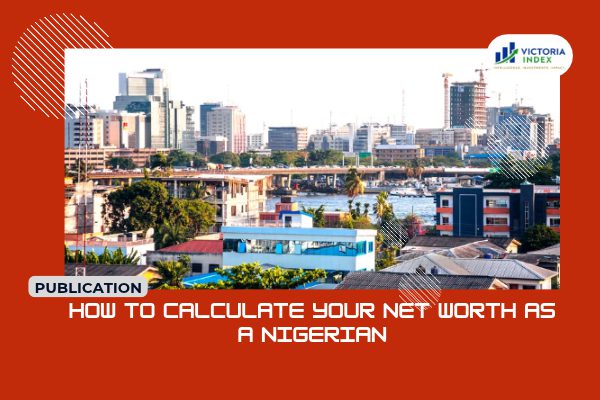
Learn how to calculate net worth in Nigeria with a simple assets and liabilities worksheet and a worked naira example.
Ask most people how they are doing financially and they will answer with their salary, their last transfer or the balance in one app. None of those numbers tells you whether you are actually building wealth. Net worth does. It is a single figure that shows what you own, what you owe and what is left, and it is the most honest scorecard in personal finance.
Calculating it in Nigeria comes with local wrinkles. Savings sit in banks, money market funds and cooperative groups. Property is often land held without a ready buyer. Pensions are locked away until retirement, and prices change fast. This VictoriaIndex guide explains what net worth is, gives a step-by-step method with naira examples, shows how to value each type of asset, and explains how to read the result so it changes your decisions and not just your mood.
Net worth is simple arithmetic: total assets minus total liabilities. Assets are things you own that have value. Liabilities are money you owe. If your assets are worth N18 million and your debts are N2 million, your net worth is N16 million.
It is a snapshot, not a verdict. A person with a high salary and heavy debt can have a lower net worth than someone who earns less but owns assets and owes little. It is also personal. A student with a negative net worth because of loans is not failing, and a retiree with a large positive figure is not necessarily safe if most of it is tied up in a house. The number only becomes useful when you track it over time and understand what is inside it. VictoriaIndex’s list of financial terms every Nigerian should understand covers words such as asset, liability, liquidity and equity if any of them are unfamiliar.
Three local realities make this exercise especially useful. The first is inflation. The National Bureau of Statistics reported headline inflation of 14.63% in September 2026, which means money that sits idle loses purchasing power every month. Net worth measured in naira can rise on paper while falling in real terms. The NBS website publishes the official consumer price data you can use to check this.
The second is currency risk. Anyone who holds dollars, imports goods or sends money abroad knows that the naira’s value against foreign currencies can shift quickly. Assets held in different currencies need to be converted at a consistent, documented rate. The Central Bank of Nigeria publishes official exchange rates on the CBN website.
The third is that many Nigerians hold wealth in informal forms: rotating savings groups, cooperative contributions, money lent to relatives, land bought in instalments and business stock. These are real assets, but they are easy to overvalue or forget, and a proper count makes them visible.
Work through six groups and write each item with its current value.
Cash and bank balances. Include current accounts, savings accounts, mobile wallets and cash at home. Use today’s balances.
Short-term savings and investments. Include money market funds, treasury bills, fixed deposits and mutual fund units. Use the current value, not what you originally put in. VictoriaIndex’s guide on how to hedge against inflation in Nigeria explains where these fit in a savings plan.
Shares and other securities. Value listed shares at the closing price on the Nigerian Exchange multiplied by the number of units you hold. The Nigerian Exchange Group publishes prices. Your holdings are recorded at the Central Securities Clearing System, and VictoriaIndex’s guide to how CSCS works explains how to confirm what you own. New investors can start with the walkthrough on how to open a stockbroking account in Nigeria.
Retirement savings. Take the balance on your latest Retirement Savings Account statement from your pension fund administrator. The Pension Commission publishes information on how the system works on the PenCom website. This is a real asset, but you cannot spend it today, so mark it as locked.
Property and big-ticket items. Include land, buildings, a car, equipment and other valuable possessions, at what they would sell for now, not what you paid.
Business and money owed to you. Include the value of your share of a business and any money others genuinely owe you and are likely to repay.
Liabilities are easier to find because they come with statements, but many people leave some out. Write down:
Use the amount needed to clear each debt today, including accrued interest, not the original loan size. Interest can make a small debt grow quickly, especially on loan apps and short-term credit, which is why this line deserves care.
Add up the assets, add up the liabilities, and subtract:
Net worth = Total assets minus total liabilities
Here is a hypothetical example. These numbers are illustrative and not an average for any group.
| Item | Amount (N) | Type |
|---|---|---|
| Bank and wallet balances | 850,000 | Liquid |
| Money market fund | 1,500,000 | Liquid |
| Treasury bills | 1,000,000 | Liquid |
| Shares on the NGX | 1,200,000 | Liquid |
| Retirement Savings Account | 2,800,000 | Locked |
| Car (current resale value) | 3,500,000 | Illiquid |
| Land (conservative value) | 8,000,000 | Illiquid |
| Total assets | 18,850,000 | |
| Personal loan balance | 1,200,000 | Liability |
| Loan app and pay-later balance | 150,000 | Liability |
| Cooperative loan | 400,000 | Liability |
| Total liabilities | 1,750,000 | |
| Net worth | 17,100,000 |
The headline number looks healthy, but the details tell a more careful story. Liquid assets, which are cash, the money market fund, treasury bills and shares, total N4.55 million. After subtracting all N1.75 million of debts, liquid net worth is N2.8 million. About 76% of total assets, which is N14.3 million, sits in a pension, a car and land, none of which can be turned into cash quickly. In an emergency, this person has far less accessible money than the headline suggests.
Land and houses. Use recent sale prices of similar plots nearby, not asking prices or what a seller told you. If unsure, apply a discount, since selling quickly often means accepting less. Do not count a plot you are still paying for at full value without subtracting what you still owe on it.
Vehicles and electronics. These lose value every year. Check what similar items are selling for today.
Foreign currency. Convert at the official rate on the day you calculate, and use the same source each time so that changes in net worth reflect real movement and not a switch in method.
Rotating savings and cooperatives. Count contributions you are sure to receive back. Do not count money you may never see.
Money lent to relatives and friends. Count only the portion you realistically expect to be repaid. Many people choose to count it as zero.
Business value. If you own all or part of a business, use a conservative valuation, such as the value of equipment and stock, and not an optimistic figure based on future dreams.
Once you have the figure, a few simple ratios help.
Debt-to-asset ratio. Divide total liabilities by total assets. In the example, N1.75 million divided by N18.85 million is about 9%. A lower figure means more of what you own is truly yours.
Liquid share. Divide liquid assets by total assets. A low share means you may struggle to find cash in a crisis even if net worth is high.
Emergency cover. Divide liquid assets by your monthly spending to see how many months you could cope without income. Many planners suggest three to six months as a starting goal, and the right level depends on how stable your income is.
Real change. Compare the percentage rise in net worth with inflation. If your net worth grew 10% over a year while prices rose 14.63%, you got poorer in real terms even though the naira figure went up.
Also separate what you control from what you do not. Your savings rate and your debt level are yours to manage. Land and share prices move on their own. VictoriaIndex’s explainer on understanding risk before you invest your money can help you judge how much volatility your assets carry.
Build a simple sheet with three columns: item, value, and date. Update it at the same time each quarter, using the same sources for prices and exchange rates. Add a line for the total, the liquid total and the percentage change since the last review. A spreadsheet is enough, though a notebook works too.
When you change your plan, use the numbers to decide where to act. If liabilities are the problem, pay down the most expensive debt first. If liquid savings are thin, build the emergency fund before buying more property. If most assets are in one place, think about spreading them. Dividend-paying shares can add income, and VictoriaIndex’s guide on how NGX dividends work explains the dates and tax details.
The usual errors are valuing assets at what you paid or hope to get, forgetting small debts such as loan apps and pay-later balances, counting money you are owed as if it is certain, mixing up cash flow and wealth, comparing yourself with other people’s figures, and calculating once and never again. A negative result is not a reason for shame. It is a starting point, and people with negative net worth often improve it quickly by clearing high-interest debt.
Net worth is assets minus liabilities, and calculating it takes an afternoon. In Nigeria, the exercise matters more because inflation erodes idle cash, currencies move, and so much wealth sits in assets that are hard to sell. Count honestly, value conservatively, separate liquid from locked assets, and track the figure every quarter against inflation. The first number you get may not be the one you want, but it is the one you can improve.
Disclaimer: This article is for educational purposes only and does not constitute financial, tax or investment advice. The figures in the worked example are hypothetical. Please seek advice from a licensed professional before making major financial decisions.