Physical Address
Victory Est, Ogombo Ajah, Eti-Osa, Lekki 101245, Lagos
Physical Address
Victory Est, Ogombo Ajah, Eti-Osa, Lekki 101245, Lagos
Nigeria Financial News, Stock Market Data, Economy & Market Analysis
Nigeria Financial News, Stock Market Data, Economy & Market Analysis
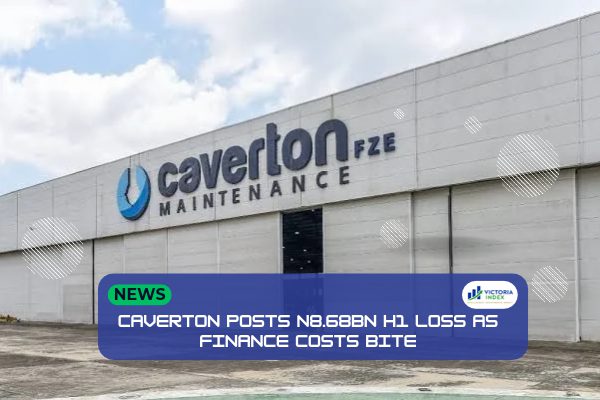
Caverton Offshore loss hit N8.68 billion in H1 2026 as N8.37 billion of finance costs swamped operations. VictoriaIndex explains why.
Caverton Offshore Support Group Plc reported a pre-tax loss of N8.66 billion and a net loss of about N8.7 billion for the six months ended 30 June 2026, a sharp reversal from a profit of about N2 billion a year earlier. The main weight on the result was net finance costs of N8.37 billion, which wiped out what little the operating business earned. Revenue fell 10.88% to N14.68 billion.
The half-year figures have since been followed by nine-month results, released in early November, that show the loss growing to N13.79 billion. This VictoriaIndex analysis covers both sets of numbers. It explains what drove the H1 loss, why debt is the central problem, what the nine-month update changes, and what shareholders should watch as the company restructures its borrowings and builds new businesses.
For the first half of 2026, Caverton reported the following, compared with the same period of 2025:
| Measure | H1 2026 | H1 2025 |
|---|---|---|
| Revenue | N14.68 billion | N16.47 billion |
| Operating result | Loss of N283.09 million | Profit of N11.57 billion |
| Net finance costs | N8.37 billion | N9.50 billion |
| Pre-tax result | Loss of N8.66 billion | Profit of N2.07 billion |
| Result after tax | Loss of N8.69 billion | Profit of N2.04 billion |
| Earnings per share | Loss of N2.59 | Profit of N0.61 |
Source: VictoriaIndex, based on Caverton Offshore Support Group Plc.
Administrative expenses rose to N7.9 billion from N4.73 billion, a jump of more than 60%, and employee benefit expenses increased to N563.22 million. Revenue also fell, driven by lower helicopter charter activity, so the group moved from a large operating profit to a small operating loss. The full unaudited statements are available on the Nigerian Exchange document library.
The figures differ slightly between reports, with the net loss given as N8.69 billion in some and a total comprehensive loss of N8.68 billion in others. That is a difference in the measure used, not a disagreement about the result.
Finance costs are the interest and related charges a company pays on its borrowings. For Caverton they are large relative to the business. Net finance costs of N8.37 billion were more than half the size of revenue of N14.68 billion. Put another way, for every naira the group earned in the half year, about 57 kobo went to servicing debt before anything else. That is a VictoriaIndex calculation from the reported figures.
The pattern is not new. In 2025, the group reported revenue of N25.76 billion, down from N40.18 billion in 2024, with finance costs of N18.52 billion and interest-bearing loans and borrowings of N65.79 billion. Reports on the 2025 pre-tax loss differ, at N13.87 billion in one and a net loss of N11.84 billion in another. Both show that debt costs have been the dominant problem for more than a year.
Why did debt cost so much? Part of Caverton’s borrowing has been in US dollars. When the naira weakens, the naira value of dollar debt and the interest on it rises. The company said it completed a restructuring of its remaining dollar-denominated bank loans to reduce this foreign exchange exposure, which it said had weighed on finance costs. VictoriaIndex’s guide to understanding risk before you invest your money explains how currency and debt risk combine to hurt companies in this position.
The company reported a first-quarter net loss of about N5.0 billion on revenue of N6.09 billion, down 32.2% from N8.98 billion a year earlier. In the second quarter, the loss narrowed to about N3.7 billion, an improvement of N1.2 billion. One report headlined a 41% revenue increase through the second quarter, though it did not make clear which period the comparison covers, so VictoriaIndex treats that figure with caution. That was the good news in the half-year release, and it is why management described the business as finding its footing.
The improvement was real but small against the scale of the debt. A loss of N3.7 billion in one quarter is still large for a company of this size.
Caverton released unaudited results for the nine months to 30 September 2026 in early November, and the board approved them on 28 October. Group revenue rose 1.4% to N20.74 billion from N20.45 billion. The company said growth in marine more than replaced the revenue lost when a major helicopter contract concluded in August 2025. Marine now generates almost a third of group revenue.
The loss after tax was N13.79 billion, against N4.63 billion in the first nine months of 2025. The company explained the widening as largely the result of N5.9 billion in non-cash depreciation following last year’s asset revaluation and the absence of a N5.3 billion one-off gain recorded in 2025. Net finance costs fell 16%, which is a reduction of N2.19 billion year on year, and the group recorded a net foreign exchange gain. Lower interest rates helped. The Central Bank of Nigeria’s Monetary Policy Committee decisions page records the 350 basis point rate cut in September that has begun to ease borrowing costs.
By VictoriaIndex’s calculation, the third-quarter loss was about N5.1 billion, which is the nine-month loss of N13.79 billion minus the half-year loss of about N8.69 billion. That is larger than the N3.7 billion loss in the second quarter. The company attributes the wider nine-month loss largely to non-cash depreciation and the missing one-off gain, and the coverage reviewed does not break the quarter down further. A non-cash charge increases the reported loss without reducing cash, but the numbers show the recovery is not yet visible in the bottom line.
Interest-bearing borrowings stood at N81.55 billion on 30 September 2026. That is higher than the N65.79 billion reported at the end of 2025, a point investors should ask the company to explain, since it could reflect the restructuring, the revaluation of dollar debt or new facilities.
Management says Caverton is in transition, and the nine-month release lays out several moves. The marine business has grown quickly, including a charter position in three Suezmax tankers through an international pool, which earns foreign currency. The group is building an indigenous electric ferry platform, which has completed sea trials on Lagos waterways, and it is constructing ten electric ferries for Lagos State.
On the aviation side, helicopter operations continue under a contract in Cameroon that runs to March 2028 with options to extend. Discussions continue with an international operator on a partnership to restore and expand flight operations. About 60% of the maintenance facility is leased to a third party, the training centre is attracting commercial use, and the drone business is developing with partners. The company also said it is in talks with prospective strategic partners on an equity investment in its aviation business, which could bring in capital without adding debt.
These plans are ambitious, and none of them has yet produced profit. A turnaround depends on whether new revenue grows faster than the interest bill, and whether the debt restructuring is completed on terms the business can carry.
Caverton’s share price has reflected the strain. One report put the stock about 35% below its mid-January level of N8.45 after the half-year results, and another recorded a price near N5.50 in August. Share prices move daily, so readers should check the current quote on the NGX.
Shareholders should also note ownership structure. The company’s first-quarter filing reported a free float of 21.77%, meaning only about a fifth of the shares are available to the public. VictoriaIndex’s explainer on market capitalization and free float for NGX investors shows why this matters for liquidity and price swings. With ongoing losses, dividends are unlikely until the company returns to profit. Anyone reading the results can use VictoriaIndex’s guide on how to analyze an NGX corporate earnings report to separate cash costs from accounting charges, and the list of financial terms every Nigerian should understand clarifies words such as depreciation, revaluation and restructuring.
Five signals matter most. The first is progress on the debt restructuring and the final terms. The second is whether net finance costs keep falling as interest rates ease. The third is revenue growth in marine, and whether the electric ferry service starts on schedule. The fourth is any equity investment in the aviation business. The fifth is the full-year result, which will show how much of the loss is non-cash.
Investors should verify announcements through primary sources. The Nigerian Exchange Group publishes company filings, and the Securities and Exchange Commission, Nigeria oversees the capital market and issues investor guidance.
Caverton’s H1 2026 loss of N8.68 billion was driven by finance costs of N8.37 billion, falling revenue and higher administrative spending. The nine-month results show revenue stabilising at N20.74 billion, marine growing and finance costs falling, but the loss widened to N13.79 billion and borrowings stand at N81.55 billion. The company is trying to reshape itself around marine, partnerships and a leaner aviation business. Until the debt is restructured and revenue grows faster than interest costs, the path back to profit remains uncertain. VictoriaIndex will continue to follow the company’s filings.
Financial disclaimer: This article is for information only and does not constitute investment advice. Figures are taken from unaudited company filings. Share prices move constantly. Please speak to your stockbroker before investing.