Physical Address
Victory Est, Ogombo Ajah, Eti-Osa, Lekki 101245, Lagos
Physical Address
Victory Est, Ogombo Ajah, Eti-Osa, Lekki 101245, Lagos

Nigeria Financial News, Stock Market Data, Economy & Market Analysis
Nigeria Financial News, Stock Market Data, Economy & Market Analysis
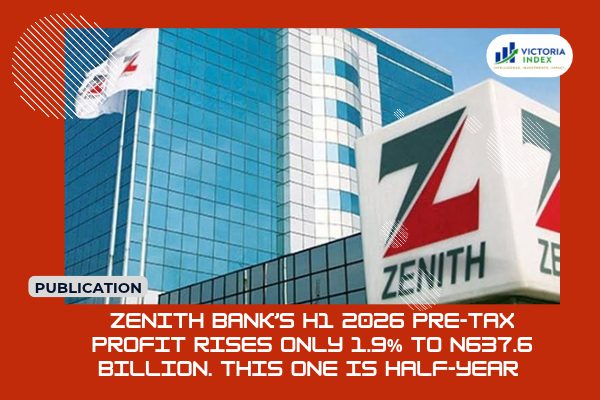
Zenith Bank’s pre-tax profit rose 1.9% to N637.6 billion in H1 2026, but tax and trading losses cut after-tax earnings.
Zenith Bank Plc has published its audited results for the six months ended June 30, 2026, and the headline looks calm. Profit before tax came in at N637.6 billion, up 1.9% from N625.6 billion in the same period of 2025. Anyone who stops at that line would assume a steady half-year for one of Nigeria’s biggest lenders. The rest of the statement tells a more tangled story, and that is the part investors, depositors and shareholders should read carefully.
In this article we go through what moved, what did not, and what the numbers suggest for the second half of the year. Where we quote figures, they come from the bank’s filings as filled on the NGX website and the Zenith Bank investor relations page, reviewed by VictoriaIndex.
| Metric | H1 2026 | H1 2025 | Change |
|---|---|---|---|
| Profit before tax | N637.6 billion | N625.6 billion | +1.9% |
| Profit after tax | N430.8 billion | N532.2 billion | down 19.1% |
| Tax expense | N206.8 billion | N93.5 billion | up about 121% |
| Gross earnings | N1.90 trillion | N2.52 trillion | down 24.6% |
| Net fee and commission income | N178.8 billion | not stated here | up 39.6% |
| Impairment charge | N141.1 billion | not stated here | down 81.5% |
| Interim dividend per share | N1.50 | N1.25 | up 20% |
The table already hints at the real story. Pre-tax profit barely moved, yet profit after tax dropped by almost a fifth, and gross earnings fell by roughly a quarter. Three different things are happening at once, so let us take them one at a time.
According to the Nairametrics breakdown, Zenith’s pre-tax profit stayed flat because two large movements almost offset each other.
The first was a collapse in impairment charges. The bank set aside N141.1 billion for expected loan losses in the half-year, about 81.5% less than a year earlier. Impairment is money a bank puts aside against loans that might not be repaid, and it goes straight through the income statement. When that charge falls sharply, profit gets a lift without a single new customer being added. Last year’s provisioning was heavy, partly because of the naira’s sharp moves and tougher credit conditions, so a lower charge this year is a welcome sign of better asset quality. It is also a one-way street. A bank cannot cut provisions by 80% every year.
The second swing went the other way. In H1 2025, Zenith booked a trading gain of N467.8 billion, largely from foreign exchange revaluation when the naira was moving rapidly. In H1 2026 that turned into a trading loss of N92.2 billion. That is a swing of well over N500 billion in a single line, and it explains most of the fall in gross earnings from N2.52 trillion to N1.90 trillion. The Central Bank of Nigeria’s foreign exchange policy has become more stable since the earlier turbulence, and you can follow the policy direction on the CBN website. Calmer currency conditions are good for the economy, but they also mean banks lose the windfall gains they enjoyed when the market was jumpy.
Strip away the one-off swings, and the day-to-day banking picture is encouraging. Dabafinance reported that net interest margin improved to 12.4% from 11.9% a year earlier, and net interest income reached about N1.25 trillion. Management credited cheaper funding, stronger transaction income and continued growth in loans and customer deposits. Net fee and commission income rose 39.6% to N178.8 billion, which suggests customers are using Zenith’s payment, card and digital channels more heavily.
This matters because fee income is steadier than trading income. A bank that earns more from fees and interest and less from currency bets is generally easier to value and easier to trust. For readers weighing the sector as a whole, our guide to the best banking stocks to buy during Nigeria’s recapitalization era puts these results in the context of the capital race.
This is the part many headlines skipped. Tax expense rose from N93.5 billion to N206.8 billion, a jump of about 121%. Profit after tax therefore dropped from N532.2 billion to N430.8 billion, even though pre-tax profit rose.
Nairametrics notes that the tax line includes a N89.9 billion charge for tax that had been under-provided in earlier periods. Without that adjustment, profit after tax would have been around N520.6 billion, only about 2% below the previous year. In other words, part of the pain in the after-tax figure is a catch-up payment for the past rather than a sign of weakening operations today.
Even so, the effective tax rate has clearly moved higher, and that is a trend to watch. Nigeria’s tax rules for banks have tightened in recent years, including the windfall levy on foreign exchange gains. Readers who want the legal background can start with the official guidance published by the Federal Inland Revenue Service and our explainer If you are weighing bank stocks, our guide on how NGX dividends work, including yield, payout ratio and qualification dates is a useful companion.
Zenith’s first-quarter pre-tax profit was N360.9 billion, up 2.87% year on year, according to its earlier filing. Subtracting that from the half-year total leaves roughly N276.7 billion for the second quarter. That is about 23% lower than the first quarter but marginally higher, by 0.68%, than the N274.8 billion recorded in Q2 2025.
The quarterly slowdown shows that the strong start to the year was not fully sustained. A softer second quarter is partly the impact of trading losses beginning to show up, and partly the normal unevenness of banking income. We would not read it as a crisis, but we would not ignore it either.
Despite the lower after-tax profit, the board declared an interim dividend of N1.50 per share, up 20% from N1.25 a year earlier. For shareholders, that is the most concrete takeaway in the whole release. It signals that management is confident about cash generation and capital strength.
There is a sharper way to look at it, though. A BusinessDay analysis points out that the final dividend already paid and the interim now declared add up to about N421 billion, which is around 98% of the half-year profit attributable to owners. A payout that high leaves little room to rebuild equity from retained earnings, so future growth leans more heavily on new capital or stronger earnings. Dividend-focused investors will like the payout, but it is fair to ask how long it can keep growing at this pace. If you are weighing bank stocks, our guide on how NGX dividends work, including yield, payout ratio and qualification dates is a useful companion.
Zenith’s foreign subsidiaries contributed a combined pre-tax profit of N166.09 billion in the half-year, which equals about 55% of what they earned in all of 2025. Zenith Bank Ghana led with N106.87 billion, while the UK arm added N33.57 billion and Sierra Leone N20.69 billion. A bank that earns from several economies is less exposed to a bad quarter at home, and this spread is one reason Zenith has been able to hold its pre-tax line steady.
First, whether impairment charges stay low. If credit quality holds, the bank keeps a tailwind. If not, the first half may turn out to have been the easy part.
Second, whether trading income recovers or stays negative. Stable currency markets reduce volatility but also reduce windfalls.
Third, the tax rate. If the higher effective rate persists, profit after tax will keep lagging pre-tax profit.
Fourth, the bank’s capital position. Nigerian lenders are working toward the new minimum capital requirements set by the central bank, and a high dividend payout competes with that goal. You can track sector-wide announcements on the CBN and NGX websites, and macroeconomic data such as inflation and GDP on the National Bureau of Statistics. For the wider market picture, see how Nigeria’s stock exchange compares to South Africa’s.
Zenith Bank’s 1.9% pre-tax growth is real, but it is a story of balance rather than momentum. Lower loan-loss provisions and stronger fee income pushed profit up, while a swing from trading gains to losses and a heavier tax bill pulled earnings down. The fundamentals of the lending business look sound, the dividend is higher, and the foreign operations are pulling their weight. At the same time, the sharp fall in profit after tax and the very high payout ratio are good reasons to look past the headline.
If you hold or plan to buy Zenith shares, read the full statements on the NGX and the bank’s own site, and If you hold or plan to buy Zenith shares, read the full statements on the NGX and the bank’s own site, and see how another listed company’s profit story played out in our report on Transcorp Group’s pre-tax profit falling to N111.4bn.
Disclaimer: This article is for information only and is not investment advice. Figures are taken from published company filings and reputable financial media at the time of writing and may be revised. Please verify with official sources before making any financial decision.