Physical Address
Victory Est, Ogombo Ajah, Eti-Osa, Lekki 101245, Lagos
Physical Address
Victory Est, Ogombo Ajah, Eti-Osa, Lekki 101245, Lagos

Nigeria Financial News, Stock Market Data, Economy & Market Analysis
Nigeria Financial News, Stock Market Data, Economy & Market Analysis
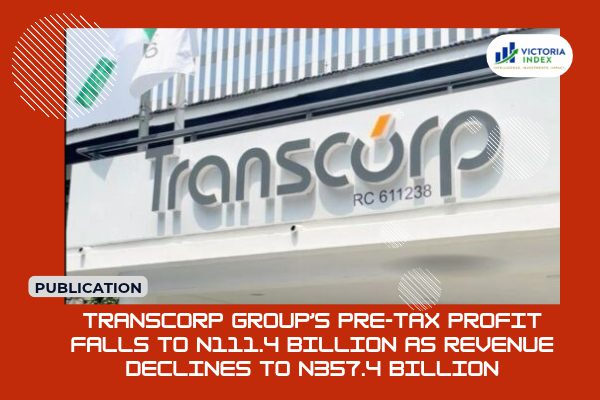
Transcorp Group pre-tax profit fell to N111.4 billion as revenue dropped to N357.4 billion, but margins and cash both improved.
Transnational Corporation Plc (Transcorp Group) reported a pre-tax profit of N111.4 billion for the nine months ended 30 September 2026, down 10.5% from N124.5 billion in the same period of 2025. Revenue fell 13.35% to N357.4 billion from N412.4 billion, and profit after tax dropped 17.8% to N75.1 billion from N91.4 billion. The unaudited results were released on the Nigerian Exchange (NGX) on 26 October 2026.
The decline is real, but the details inside the report are more mixed than the headline suggests. Profit fell by less than revenue, the pre-tax margin widened, and the balance sheet grew stronger. This VictoriaIndex analysis explains what pulled revenue down, how the group protected its margins, what the subsidiaries contributed, and what investors in the TRANSCORP stock should watch next.
Revenue of N357.38 billion was 13.35% lower than the N412.43 billion recorded a year earlier. Pre-tax profit slipped 10.54% to N111.39 billion, and profit after tax declined to N75.1 billion. Tax expense rose to N36.30 billion from N33.11 billion, which is why the after-tax fall of 17.8% was larger than the pre-tax fall of 10.5%.
The comparison base matters. In the first nine months of 2025, Transcorp reported revenue growth of about 39% to N413.4 billion and pre-tax profit growth of 18%, driven largely by its power business. Matching a period that strong was always going to be difficult, and the 2026 figures should be read against that high bar.
The main reason is the power business. Transcorp Power, the group’s largest operating segment, evacuated less electricity during the period. The group’s chief financial officer linked the shortfall to transmission and gas supply constraints, which have limited output across the industry, including problems arising from damage to transmission and gas infrastructure.
This distinction is important. A generating company can have plants ready to produce, but it earns energy revenue only for the electricity that actually reaches the grid and is paid for. When the grid cannot take the power, or gas does not arrive, output drops. Capacity charge revenue, which is paid for being available to generate, held up better and rose to N72.79 billion from N70.20 billion. Energy sales, which depend on actual delivery, fell.
The subsidiary’s numbers show how heavily the group leans on it.
| Transcorp Power Plc | 9M 2026 | 9M 2025 | Change |
|---|---|---|---|
| Revenue | ₦266.1bn | ₦308.5bn | -13.7% |
| Profit before tax | ₦83.1bn | ₦91.2bn | -8.9% |
| Pre-tax margin | 31.2% | 29.6% | +1.6 points |
| Shareholders’ funds | ₦199.8bn | n/a | +8.9% |
| Cash | ₦10.3bn | n/a | +365% |
Transcorp Power’s own results show the same pattern. The subsidiary reported a nine-month pre-tax profit of N83.1 billion, down from N91.18 billion a year earlier, with revenue lower by about 13.7%. Reports also note that the group’s hospitality and food businesses saw some revenue declines. The industry-wide nature of the power problem means it is not unique to Transcorp. Readers who want official information on the sector can consult the Nigerian Electricity Regulatory Commission, which regulates electricity generation, transmission and distribution.
The group’s pre-tax margin widened to 31.2% from 30.2%. In plain terms, Transcorp earned about 31 kobo of pre-tax profit from every naira of revenue, compared with about 30 kobo a year earlier. That improvement shows that costs came down faster than sales, or at least did not rise in step with them.
The third quarter alone, which we calculate by subtracting the half-year results from the nine-month figures, tells a more cautious story.
| Derived quarter | Q3 2026 | Q3 2025 | Change |
|---|---|---|---|
| Revenue | ₦115.9bn | ₦133.4bn | -13.1% |
| Profit before tax | ₦35.5bn | ₦38.8bn | -8.5% |
| Profit after tax | ₦20.7bn | ₦26.2bn | -21.0% |
| Pre-tax margin | 30.6% | 29.1% | +1.5 points |
Management credited cost discipline across the portfolio and the strength of the group’s diversified structure. A conglomerate with several businesses can absorb a weak patch in one area by controlling costs or leaning on another. Here, power remained the dominant earner but not the only one. A margin expansion during a revenue decline is a positive sign, although it cannot continue indefinitely, because there is a limit to how much cost can be cut before activity suffers.
While earnings softened, the balance sheet moved the other way. Total assets rose about 13% to N1.13 trillion, and total equity increased 9.7% to N387.8 billion. Cash more than doubled to N45.9 billion, giving the group more room to meet obligations and fund investment.
Transcorp Power grew its shareholders’ funds by 8.9% to N199.8 billion and increased its cash more than fourfold to N10.3 billion. Transcorp Hotels increased its profit after tax by 5% to N15.5 billion, widened its net profit margin to 22.3%, cut net finance costs by 36% and grew total assets by 29% to N206.8 billion. These figures show that the group’s non-power businesses are contributing steadily even as power revenue falls.
The quarterly picture shows how the year has unfolded. Transcorp reported first-quarter revenue of N125.1 billion with pre-tax profit of N50.7 billion. At the half-year, revenue was N241.5 billion, down 13.44%, and pre-tax profit was reported at N75.9 billion in coverage of the half-year results. Using those half-year and nine-month figures, VictoriaIndex calculates that third-quarter revenue was roughly N115.9 billion and pre-tax profit about N35.5 billion. Against the third quarter of 2025, which reported revenue of about N133.8 billion and pre-tax profit of N38.8 billion, that implies declines of roughly 13% and 8.5%. These quarterly figures are VictoriaIndex’s calculations from reported totals and are approximate, so readers should check them against the company’s quarterly statements.
The takeaway is steadiness. The decline in revenue has been consistent at around 13% throughout the year, and the group’s pre-tax profit has fallen by a smaller percentage, which fits the margin story.
For shareholders, the central question is whether the revenue decline is temporary. If transmission and gas supply constraints ease, the same cost base could support a larger top line, since much of the fixed cost of running power plants is already in place. If the constraints persist, margin defence becomes the group’s main earnings lever, and that has limits.
The stronger cash position and equity are useful buffers, and they matter for anyone interested in dividends. A company’s ability to pay dividends depends on profit, cash and its own capital plans. VictoriaIndex’s guide on how to analyze an NGX corporate earnings report shows how to check those items yourself, and its explainer on market capitalization and free float for NGX investors helps put the share price in context.
It also helps to compare with other listed companies reporting this season. VictoriaIndex’s analysis of the best banking stocks to buy during Nigeria’s recapitalization era looks at a very different sector, where funding costs and tax rather than infrastructure drove results.
Four things deserve attention in the coming quarters. The first is power evacuation, which depends on grid performance and gas supply, neither of which the group controls. The second is the tax charge, which rose faster than pre-tax profit and trimmed the bottom line. The third is the pace of cost savings, since margin gains may not repeat. The fourth is the performance of hospitality and other non-power units, which now matter more to total earnings.
Investors should verify announcements through official sources. The Nigerian Exchange Group publishes company filings and corporate actions, and the Securities and Exchange Commission, Nigeria regulates the capital market and issues investor guidance. The full unaudited statements are part of the company’s filing on the NGX.
Transcorp Group’s pre-tax profit fell 10.5% to N111.4 billion because power evacuation constraints cut revenue by 13.35%, but cost control lifted the pre-tax margin to 31.2% and cash more than doubled to N45.9 billion. After-tax profit fell further, by 17.8%, because the tax charge rose. The group is smaller in revenue this year but financially stronger, and the next few quarters will show whether the grid and gas supply problems ease. VictoriaIndex will continue to follow the company’s filings and report on developments.
Financial disclaimer: This article is for information only and does not constitute investment advice. Figures are taken from unaudited company filings and published reports and may change. Please do your own research or speak to a licensed adviser before investing.