Physical Address
Victory Est, Ogombo Ajah, Eti-Osa, Lekki 101245, Lagos
Physical Address
Victory Est, Ogombo Ajah, Eti-Osa, Lekki 101245, Lagos
Nigeria Financial News, Stock Market Data, Economy & Market Analysis
Nigeria Financial News, Stock Market Data, Economy & Market Analysis
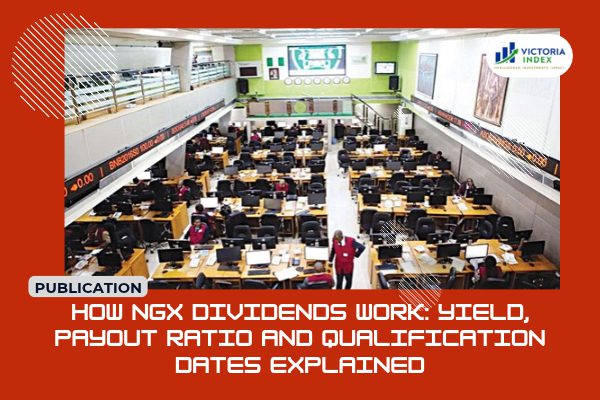
NGX dividends explained: learn how dividend yield, payout ratio and qualification dates work so you can claim what you earn.
Every year, billions of naira move from listed companies to shareholders in the form of dividends, and every year some investors miss out on money they thought they had earned. The usual reason is simple. They bought shares after the qualification date, they never completed an e-dividend mandate, or they misjudged what a headline dividend figure really means for their returns.
NGX dividends follow a clear process, and once the terms are understood, the process is easy to follow. This guide from VictoriaIndex explains what a dividend is, how the key dates work, how to calculate dividend yield and payout ratio, how tax applies, and the practical steps that help a payment reach your bank account on time.
A dividend is a share of a company’s profit that the board decides to pay out to shareholders instead of keeping inside the business. It is paid per share, so an investor who owns 1,000 shares and receives N2 per share is paid N2,000 before tax. The decision belongs to the directors, and final dividends need the approval of shareholders at the annual general meeting (AGM). No company is obliged to pay one, which is why dividends are never guaranteed.
Companies listed on the Nigerian Exchange (NGX) usually pay in two forms. An interim dividend is declared during the financial year, often after the half-year or a quarterly result. A final dividend is proposed after the full-year accounts are completed and then approved at the AGM. Some companies also announce bonus shares, where shareholders receive extra shares instead of, or alongside, cash. A common example is one new share for every three held on the qualification date.
Readers who want to understand the profit figures behind these payouts can start with VictoriaIndex’s guide on how to analyze an NGX corporate earnings report, since dividends come out of reported earnings and cash.
Almost every dividend announcement filed on the NGX carries the same set of dates. Understanding each one removes most of the confusion.
The qualification date, sometimes called the record date, is the cut-off. Only shareholders whose names appear on the company’s register at the close of business on this date are entitled to the dividend. Buy after it and you are not on the list for that payout.
The closure of register is the period, or sometimes a single day, when the registrar closes the share register to new entries so it can prepare payment records. It usually begins the business day after the qualification date.
The AGM date is when shareholders vote on a proposed final dividend. For an interim dividend, the board’s declaration is generally enough.
The payment date is when the money is sent. Payment is made electronically to shareholders who have completed an e-dividend registration.
A real filing shows how this looks in practice. In its dividend announcement for the 2025 financial year, Dangote Cement filed on the NGX document library a qualification date of Wednesday, 17 June 2026, closure of the register on Thursday, 18 June 2026, and payment by Thursday, 2 July 2026. The same pattern appears in an Ecobank Transnational Incorporated dividend announcement, which set the qualification date at close of business on 12 June 2026 and payment on 30 June 2026.
Timing matters because a trade does not settle instantly. Shares bought on the exchange take a short period to settle in the buyer’s account, so an investor who wants a dividend should buy several trading days before the qualification date, not on the last day. Always confirm the settlement timeline with your stockbroker. VictoriaIndex’s guide to how the Central Securities Clearing System works explains why your ownership record at the CSCS is what ultimately counts.
Cash dividends on the NGX are paid directly into bank accounts, not by cheque. To receive the money, a shareholder must complete an e-dividend mandate with the company’s registrar, giving their bank details. Company announcements repeatedly urge shareholders who have not done so to register, and many also remind holders of unclaimed dividend warrants and share certificates to contact the registrar.
The mandate process runs through the e-dividend Mandate Management System, known as e-DMMS, operated by the Nigeria Inter-Bank Settlement System (NIBSS). Company filings, such as Custodian Investment’s corporate action notice, direct shareholders to the NIBSS e-DMMS self-service portal to complete their registration.
Names must match across records. If the name on your share register differs from the name on your bank account, even slightly, the payment can fail. Investors who are new to the market should also make sure their stockbroking account is correctly linked to their CSCS record. VictoriaIndex’s walkthrough on how to open a stockbroking account in Nigeria covers the setup steps.
Dividend yield tells an investor how much income a share pays relative to what it costs. The formula is annual dividend per share divided by the current share price, multiplied by 100.
Take an illustrative example. If a share trades at N500 and the company pays N25 per share in total during the year, the yield is 5%. If the price rises to N1,000 while the dividend stays at N25, the yield falls to 2.5%, even though the payout has not changed.
Two cautions apply. First, a very high yield can signal trouble. If the price has fallen sharply because investors expect profits to drop, the yield looks high just before the dividend is cut. Second, yield should be judged against what safer assets pay and against inflation. The Central Bank of Nigeria publishes its policy rate decisions and monetary data, and the National Bureau of Statistics releases the consumer price index and inflation figures. Comparing a stock’s yield with both gives a more honest picture of its real return. VictoriaIndex’s explainer on how to hedge against inflation in Nigeria shows how dividend income fits among other options.
The payout ratio shows what share of profit a company distributes. It is calculated by dividing dividend per share by earnings per share, then multiplying by 100.
Suppose a company earns N40 per share and pays N20. Its payout ratio is 50%, which leaves half of the profit inside the business for growth or debt repayment. A ratio above 100% means the company paid out more than it earned that year, which is rarely sustainable unless it is drawing on reserves or one-off gains.
There is no single ideal number. Mature businesses with stable cash flow often pay out a large share, while companies investing heavily in expansion pay less. What investors should watch is consistency. A company that pays a steady or rising dividend while keeping the payout ratio at a comfortable level is usually in a stronger position than one that pays a large dividend once and then skips years. Checking cash flow alongside profit also helps, because dividends are paid in cash. For help with the terminology used here, see VictoriaIndex’s list of financial terms every Nigerian should understand.
Dividends paid by Nigerian companies are subject to withholding tax at 10%, deducted at source before the money reaches the shareholder. For individual investors, this withholding tax is generally treated as the final tax on that income. The company or its registrar remits the amount to the tax authority, now the Nigeria Revenue Service (NRS) under the tax reform laws that took effect on 1 January 2026. The Federal Inland Revenue Service page on withholding tax administration remains a useful reference, and taxpayers should confirm current guidance directly with the revenue authority or a licensed tax adviser.
A simple example shows the effect. An investor holding 1,000 shares of a company that pays N45 per share, as Dangote Cement announced for its 2025 results, would receive N45,000 gross. Withholding tax of 10% takes N4,500, so the net payment is N40,500.
Many missed or disappointing payouts trace back to a handful of errors. The first is buying on or after the qualification date and expecting the current dividend. The second is skipping the e-dividend mandate, which leaves the payment stuck with the registrar. The third is ignoring a mismatch between share register and bank account names. The fourth is chasing a high yield without checking the payout ratio and profit trend. The fifth is forgetting that shares often fall in price after a dividend is paid, because the cash has left the company. A dividend is part of total return, not a free gain.
Dividend announcements should always be checked against official sources. The Nigerian Exchange Group publishes corporate action filings for every listed company, and the Securities and Exchange Commission, Nigeria oversees the capital market and issues investor protection guidance. Social media posts and forwarded messages about dividends are not reliable proof of a payout.
Dividend investing also carries risk. Companies can cut or suspend payments when profits fall, and share prices can decline by more than the income received. VictoriaIndex’s primer on understanding risk before you invest your money is a good next read. For context on how company size and tradable shares affect an investment, see the guide to market capitalization and free float.